Monday, June 4, 2012

Gays in Sports: A Decade Later

-- by Matt Hurst

I realized early in my journalism career that game recaps and cheery feature stories weren't the best way to build up my clips package. As I aimed to work at bigger newspapers, I had to tackle bigger issues. Therefore, I had to write bigger stories that would challenge my writing, my reporting and my comfort level asking tough questions.

My first job out of college found me working at a small paper - the Vallejo Times-Herald - and allowed me to work on these aspects whereas if I had started as an intern at, say, the Los Angeles Daily News, I wouldn't have been allowed to explore these stories, let alone ask any editors for their approval when I pitched them.

My sports editor at the 25,000 circulation looked at me sideways when I mentioned my idea: a story about why the public did not know any homosexual athletes in major professional team sports.

"You sure you want to do that?" he said.

I nodded. It wasn't just for my clips. It was a story I wanted to dig in to.

(Tangent: It's a story I'm still interested in as Josh and I discussed in our latest podcast. I find it fascinating that as a population, we are worried about homosexuals and that our backwards American values prevent the majority of the population from accepting it. As some comedian once said "If gays want to get married, let them. They can miserable just like every other married couple." I also chuckle at the thought that Mike Piazza held a news conference to tell everyone he was not gay.)

***

It was the back story that interested me the most.

As the Editor-in-Chief of a left-thinking college newspaper at a left-thinking university (are there any right-thinking universities?) I was faced with overseeing almost-daily social acts from various groups around campus. I had gotten to know Harley Augustino on a somewhat friendly basis because he always seemed to be involved in every active party.

He was marching with gays. He was protesting an Oliver North appearance. Despite being white, he was out front with several ethnic groups.


I learned, from a mutual friend, that Harley was an exceptional athlete in high school. I was pretty good myself, but not good enough to play in college. Yet, I played in a weekly baseball league that would include our university's Division I players during the summer, as well as any local D-I guys who returned home. It wasn't your typical beer league, let's put it that way.

One day, Harley asked me about it and I told him we needed another player, specifically a pitcher. He said he could pitch a little.

What a liar.

He fired bullets to me all day. His curveball was so devastating I had trouble catching it. We won in a romp and Harley befuddled the other team all day. He was the best pitcher I ever caught and I was glad I didn't have to face him.

I knew not to ask him about why he wasn't pitching for UC Santa Barbara. Our mutual friend had already told me why.

Harley didn't play because of the atmosphere around baseball locker rooms.

***

When I worked on the story in the winter of 2002, Harley was the last person I called.

I wanted to get as much information as possible from everyone else before I called him. I spoke with Vallejo-area high school coaches and athletes and the coup de grace - in my mind - was when I spoke with Andre Carter of the San Francisco 49ers and Lincoln Kennedy of the Oakland Raiders. Both were completely honest and Carter basically said what people do behind closed doors doesn't bother him while Kennedy said it wouldn't work for homosexuals to come out since there was too much homophobia "across the league."

I can't believe, how in 2002, a lot of people were saying the same things they are now saying a decade later. It's incredible to think there has been no change on this front, yet so many other things have happened (the Internet explosion, social media, a black President, the Red Sox winning two World Series).

It was Harley's interview that really helped the story. He was happy to speak about it openly, on the record, and didn't pull punches. It was exactly how he was when I knew him at UCSB. And, it was his final quote in my story that I still think about whenever this subject arises.

"I think you have a lot of closeted players out there, who either love the game so much they are willing to put up with it and lead a double life, which is taxing for people. There are a lot of athletes who don't go in that direction because of that.

"Maybe because of homophobia we are losing some great athletes."

To read the entire story I wrote 10 years ago, it follows after the jump


Sharpie Scribbles -- Chapter IV, Dave Henderson


--by Josh Suchon

Note to readers: The feedback on the “You Were Lucky, Hershiser” story was so positive, and triggered so many memories from a childhood where my playground was the Oakland Coliseum, I’ve decided to share more of these stories. I’m blatantly stealing this idea from “Cardboard Gods” author Josh Wilker, who used his baseball card collection to tell the story of his childhood in the 1970s. Wilker gave me his blessing, so I’m going to use my autograph collection to tell the story of my childhood in the 1980s.


When I reflect on my childhood experiences with Dave Henderson, the following items come to mind first:

1, Hendu often wore all-white jump suits and was totally paranoid that our Sharpies would get on his clothing when he stopped to sign autographs in the player parking lot.

2, Hendu had not one, but two fan clubs in the Coliseum bleachers. “Hendu-land” was the last section of bleachers in left-center before the batter’s eye. “Hendu’s Bad Boy Club” was in right-center, a section without stairs going down because the batting cage was below.

3, Hendu had a gap between his front teeth, on display whenever he flashed that awesomely goofy grin. He flashed that grin when he signed my “One Strike from Boston victory” 1987 Fleer card, and somebody asked him about those playoffs.

4, Hendu’s performance in 1988 made me forget about the departure of Dwayne Murphy, one of my favorites and the last remaining member of the A’s 1981 playoff team.

5, Hendu coined the term “Fly Boys” for the two biggest legends in the bleachers.


Mike Kelly and Jay Didier were rock stars among the regulars who showed up for autographs, chased batting practice home runs, cheered on the A’s from the bleachers, stuck around postgame for more autographs, then did it all over again the next day.

Their rock-star status, at least to me, was based on their ability to fly down the stairs. Yes, fly.


They put the open side of their gloves on the railing, bent their elbow so it was pointed down, leaned in, reached back with their bare right hand further up on the railing, and slid down -- knees bent, feet in the air, hair flying.

Their feet never touched the steps. They were a blur. They were down the steps so much faster than everybody else, they’d get just about any ball that didn’t land in the seats.

In my last posting about Curt Young and Rick Honeycutt, I wrote about how Didier was an older guru. You listened to Didier.

You idolized Kelly.  He invented the sliding down the railing technique, and was clearly the best. He was a few years older than me, and was an incredible athlete. I once played catch with him in the parking lot – between autograph time, and BP time, you had to get your arm loose – and couldn’t believe his arm.

Mike Kelly was like Kelly Leak from the Bad News Bears. Kelly even had long hair, like the fictional Kelly.

I wanted to be like Mike.

I wanted to glide down those railings, using just my glove, my feet never touching the steps, hit the ground, find the ball in the air, run underneath it, and catch home runs on the fly. I wanted kids a few years younger than me to idolize me and ask me to show them how I flew down the railing like that.

I went to my high school on weekends – you know, so nobody would see me looking like an idiot -- and practiced trying to slide down railings with my glove.

Try as I might, I couldn’t do it. Couldn’t generate the balance. Couldn’t generate the speed. Couldn’t generate the courage to go that fast, and trust myself that I wouldn’t do a face-plant. I even tried to lather up my glove with oil for better sliding. It didn’t work.

Best I could do is run down about two-thirds of the way, and somewhat slide down the last 4-5 steps. In reality, it was more like me jumping down the last steps than gliding down on a glove.

Kelly and Didier were among a group of about 20 that sat in the same bleacher section each game: second section over from the steps in left field. When the A’s reached the playoffs in 1988, the group didn’t have access to playoff tickets because they weren’t official season-ticket holders, even though they went to every game. The bleachers were sold day-of-game only.

That group wrote a letter to then-A’s owner Walter Haas, explaining their situation and asking for assistance. Not only did Haas make sure they were in the Coliseum for every playoff game, he made sure they were seated in their section and in the first two rows – their usual spot. (Another reason Haas was such a beautiful man and owner.)

This meant Kelly was in the front row, aisle seat, closest to the railing. Didier was next to him.
In Game Three of the 1988 American League Championship Series against the Red Sox, Kelly accomplished something that I have no way to prove is true, but I can’t imagine anybody else has ever equaled: catch three home runs in a single playoff game.

Mark McGwire, Carney Lansford and Hendu hit home runs over the left field wall in about the same area. Kelly, flying down the railing, way before everybody else, ended up with all three. (Ron Hassey, a lefty, pulled his home run to right field.)

I didn’t have tickets for that game. I remember watching it on TV with my dad, seeing the blur that is Kelly flying down the stairs, and thinking, “I bet Mike ended up with all those home runs.”

When I got to the Coliseum the next day for Game Four, my guess was accurate. He got ’em all. Each ball was secured in a separate plastic bag with all the details, and he was trying to get them autographed, just like he did with all his home run balls. The dude was incredible.

Watching Kelly was awesome, yet utterly intimidating. You had so few chances to get home runs -- in batting practice or the game -- because he got so many. And if Kelly didn’t get it, Didier would. You had to pick another section to patrol, but their section was the prime real estate.

My seats varied at the Coliseum. My dad bought 20 games annually from his friend and the seats were incredible -- section 123, row 2, aisle seat 13 and 12 -- just one section over from the A’s dugout.

For the other 20-35 games I would attend with my friends, we’d buy the cheapest seats and bounce around. I loved the first row of the second deck, right behind home plate, for the view of the field and the chance to get foul balls. Another favorite spot was down the left-field line, near the A’s bullpen. We ended up in the bleachers quite a bit too.

I still ended up with about 25 major league balls over a four-year period. By comparison, 25 balls was probably a home stand for Kelly. If the baseball was a brand-new white “pearl,” I’d use it to get autographs. The best part of getting a ball was actually bringing it to Little League practice, asking if somebody wanted to play catch, and waiting for them to notice what kind of ball we were using.

All the baseballs that I obtained were during batting practice. Much to my dismay, I never caught a home run ball.

On opening day 1989, I thought for sure I had my first. My friends and I sat two sections over from The Fly Boys, so we could be in the front row too, and have a better chance.

Facing Dave Stewart in his first major league at-bat, Ken Griffey, Jr. ripped a ball into the left-center gap. Off the bat, I saw it coming right toward us. Without hesitation, I sprinted down the steps, head down so I wouldn’t trip, jumped the last few steps, hit the ground, and realized that I was ahead of everybody. This historic ball would be mine for sure.

Then I realized why I was alone down there. The ball didn’t go over the fence. It one-hopped the wall. It was only a double. When I came back up the stairs, I was mocked for thinking the ball was gone. I couldn’t help it. If I was going to beat “The Fly Boys” for a ball, I had to run before I could judge if the ball was gone or not.

Mike Kelly and Jay Didier were everywhere. I went to spring training with my Dad, and who did I see there? Mike and Jay. 

It seemed like Kelly always had the best 8x10 photos to get signed. You’d usually see the same photos at card shows, but Kelly had photos that I never saw anywhere else. I asked him one day where he gets them, and he told me about a store along the Peninsula, close to where he lived.

By then, my friend Todd Strong had his driver’s license, so we made our way to the store. The selection was heaven. They had 8x10 photos of the stars, the top prospects, and the most random players. They had 8x10 photos of practically every A’s player, including Hendu, so I bought one and got it signed.

Going through the photo binders one day, I did a double-take at the background of an 8x10 Jeffrey Leonard photo. A lot of those photos were taken in spring training. I recognized the Mariners old field in Tempe, and recognized the guy in the background with his shirt off and wrapped around his head.

It was Mike Kelly.

He was everywhere.

That's Mike Kelly under Leonard's arms.
***

Mark Saxon was the A’s beat writer for The Oakland Tribune from 2000-03. I was the Giants beat writer those four years. Saxon took a job with The Orange County Register after the 2003 season, and I was given the choice of whether to continue covering the Giants or switch to the A’s.

The Giants are the bigger story in the Bay Area by a longshot, but the A’s mean more to The Oakland Tribune. It was a guarantee I’d be above the fold on the front page of the sports section every day. The A’s still had Tim Hudson, Mark Mulder and Barry Zito for star power, and I could get away from the circus of covering Barry Bonds every day. The decision was a no-brainer.

Besides, after all those years getting Sharpie Scribbles at the Coliseum, telling World Series heroes they were lucky, chasing Jose Canseco around the parking lot, and having a man-crush (before I knew what a man-crush was) on some dude who slid down the railing named Mike Kelly, it was time to come full-circle and cover the A’s. 

The Coliseum, as my work place, was much different than the Coliseum as my childhood playground.

The renovations to accommodate the Raiders ruined the bleachers. They were never the same. Most of the characters from those days stopped going to games, or sat somewhere else. Still, every day when I was on the field during batting practice, I’d look into the crowd and wonder if I’d ever see Mike Kelly or Jay Didier again.

For four years of my childhood, they were everywhere.

Now, they were gone.

As I’ve mentioned before, I didn’t talk about my childhood at the Coliseum very often with work colleagues. I’m sure they didn’t care, I didn’t want them to think I was some closet A’s homer who wasn’t objective, and it’s somewhat embarrassing what a baseball nerd I was back then.

One night though, I think at a bar in Kansas City over multiple vodka and red bulls, I was out with one of the guys from the A’s television crew named David Feldman. The conversation turned to the Coliseum bleachers in the late 1980s. Turns out, he always sat in the same bleacher section with Mike Kelly and Jay Didier.

Feldman didn’t know where the “Fly Boys” are now, but he knew them well back in the day.

We didn’t know each other in the 1980s, mostly because Feldman wasn’t into getting autographs, but we knew many of the same Coliseum Characters, and we’d spent countless nights sitting very close to each other at the Coliseum as teen-agers.

Now, we were on the road with the A’s, talking about Mike Kelly.

What a life.

***

The last remains of my ball collection from the 1980s.
When I was going through my Sharpie Scribbles recently, I saw Mike Kelly’s name and phone number written on the bottom of the cardboard box that I always brought to games to store my cards.

For over two weeks, I debated whether I should call the number. I knew it was a land-line. Nobody had cell phones back then. I figured it was his parent’s number. I could explain my story, explain this blog, and maybe they would give me his number.

Last night, I finally decided to go for it. I dialed the number. Not surprisingly, nobody at that number knew Mike Kelly. I was actually relieved.

Sure, it would be fun to talk with him, see if he remembered me, reminisce about those good ol’ days, ask how he invented the sliding down the handrail technique, and hear what he’s doing with his life these days.

Then again, what if he was a mess? Or a drug addict? Or fat and unable to play catch? Or worse yet, what if he still went to games and tried to get autographs and home runs balls, and hadn’t cut his hair since the 80s? 

I’d rather remember Mike Kelly as the guy who ruled the Coliseum outfield beyond the fences, the way Dave Henderson ruled the Coliseum outfield inside the fences.


Sunday, June 3, 2012

The ultimate coming-OUT party

A number of prominent NFL players, past and present, recently told OutSports.com that they'd have no problem welcoming an openly homosexual player into the locker room. In this latest Out of Ink Podcast, Josh and Matt discuss how close we are to this happening, the type of athlete needed to break this "barrier," what regions of the country would be most accepting, and the type of teammates needed.

Friday, June 1, 2012

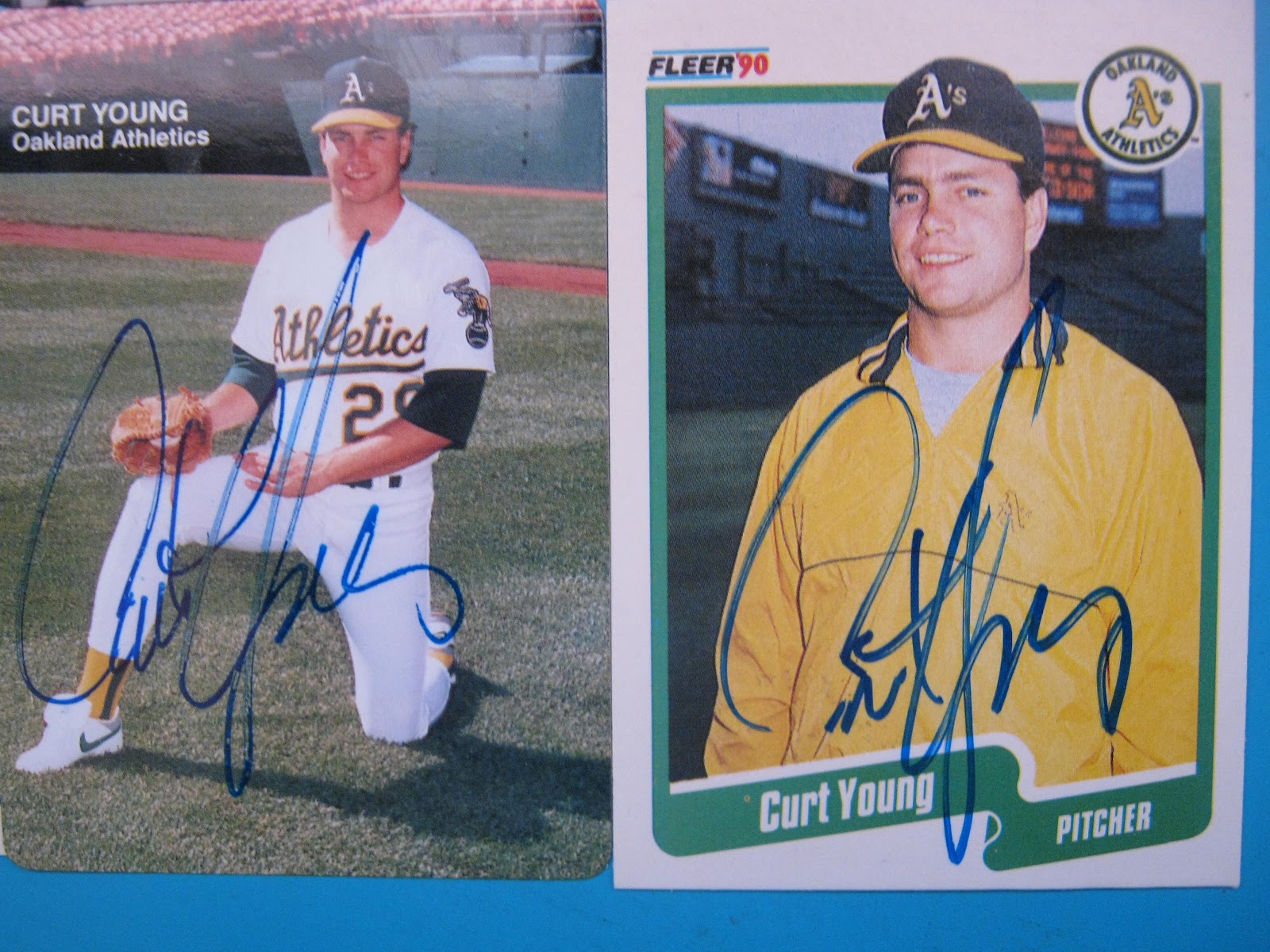
Sharpie Scribbles -- Chapter III, Curt Young and Rick Honeycutt


-- by Josh Suchon

Note to readers: The feedback on the “You Were Lucky, Hershiser” story was so positive, and triggered so many memories from a childhood where my playground was the Oakland Coliseum, I’ve decided to share more of these stories. I’m blatantly stealing this idea from “Cardboard Gods” author Josh Wilker, who used his baseball card collection to tell the story of his childhood in the 1970s. Wilker gave me his blessing, so I’m going to use my autograph collection to tell the story of my childhood in the 1980s.

In the early days of my autograph collecting, tact wasn’t my forte. Honestly, I was a total spaz.

When I saw a player’s car pull into the parking lot, I sprinted as fast as I could to the car. One time, I nearly got hit. I wasn’t very organized. I’d have all my baseball cards in hand, shuffling through them nervously, and sometimes drop cards. The process of handing over a card and pen to a player, then getting it back, was always awkward.

It didn’t occur to me to give the ballplayer room to get out of his car. I was too busy trying to box-out other autograph seekers for the best position. I’m sure the players thought I was the most annoying kid ever.

The first few days, I used a ball-point pen on baseball cards, the ultimate sign of an amateur. The first Sharpie that I bought was red, which is probably the worst color for autographs. Another rookie mistake.

What finally taught me to calm down was an experience with A’s pitcher Curt Young. A few A’s pitchers would carpool to the Coliseum on a regular basis. It wasn’t the same people every day, but I recall that some combination of Young, Gene Nelson, Rick Honeycutt and Dennis Eckersley were usually together.

One day, early in the 1987 season, I was in ultimate spaz mode as I sprinted up to Curt Young. The conversation went something like this:


 Me: Mr. Young, can I have your autograph!!!

Young: NOOOOOO!

Devastated, I turned back around. The other autograph seekers were laughing. I thought they were laughing at me. But really, they were laughing because Young was laughing.

Young was just kidding.

Wasn’t much else to the conversation, except everybody laughing at me. I recall that Young said something along the lines of, “I’ll sign. Just relax, kid.”

Young signed for me that day, and pretty much every day that I asked him the next four years. As I look back on the collection now, I see at least nine Young autographs. I know for sure the first one -- when Young yelled “NOOOO” -- was the 1986 Topps Card because it’s in a red pen and you can barely see the signature.

Young’s carpool mates were all among the coolest players on those A’s teams – and when I say coolest, I mean the easiest to get their autograph. We didn't have to sprint across the Coliseum to a different parking lot, only to get turned down by Jose Canseco.

Rick Honeycutt was another. I remember Honeycutt as somebody who’d always sign, but I didn’t realize that he was a serious threat to Cory Snyder for the “most autographs in my collection” title.

I have 13 Snyder’s -- on 12 different baseball cards and an 8x10 photo.

I have 12 Honeycutt’s -- all on baseball cards. If somebody made 8x10 photos of setup lefty relievers, I’d have probably bought it, Honeycutt would have signed it for me, and he’d be tied with Snyder on that all-time list.

Out of the 12, three are him as a Ranger, three are him as a Dodger, and six are him with the A’s. You’d think that after getting 12 autographs of somebody, you’d have an interesting story. Or five. Honestly, I can’t think of even one, and I’m racking my brain.

Honeycutt signing autographs in the parking lot was like Honeycutt on the mound in the seventh and eighth innings of a close game. Nothing special. Nothing legendary. Nothing flashy. Just always get the job done.

My favorite Honeycutt autograph is on the 1990 Upper Deck card because he’s pictured signing an autograph. Is there anything cooler than asking a player to sign a baseball card of himself that depicts him signing autographs? It’s almost like it’s impossible for him to say no. In my warped teen-age mind, Honeycutt loved signing that card more than any other card too.

Honeycutt’s expression as he’s signing that autograph is how I remember him: stoic, matter-of-fact, and focused on signing his name in a legible way.

The trio of Nelson to Honeycutt to Eckersley was the best in baseball at saving games in the late 1980s. Fittingly, they carpooled together at times, and us autograph hunters in the Coliseum parking lot learned that teamwork would lead to more Sharpie Scribbles for everybody.

You see, if everybody went up to Eckersley and waited for him, the other players would walk into the clubhouse without signing. But if an equal number of autograph seekers went to each player, they’d all stop and sign, and you had time to double- and triple-back to get everybody. You just had to trust each other to get the job done, just like the relievers did.

It took me a few games, and a loud “NOOO” from Curt Young, to learn that.

One of the veterans of the autograph-seeking group was a guy named Jay Didier. He was a wise man, like the Yoda of autograph seekers, and taught me a lot. My recollection now is that he was in his early 30s back then, but hell, I could be 10 years off, older or younger.

A few of my friends – Chris Poulson, Corey Kell, Jim Putt and Todd Strong – were one year older than me in school and started collecting autographs just a little before I did. They knew the unwritten rules, and tried to teach me. They were my peers, so I didn’t listen to them. But I listened to Didier.

Didier taught me obvious things, such as, let the player get out of his car. Didier taught me how to ask a player for an autograph, how to hold a pen (don’t laugh, there’s an art to it), how to carry yourself, how to choose the right item to get autographed, and a lot more about life.

On Sept. 30, 1987, when Dave Stewart was trying for his 20th win, he stopped to sign autographs in the parking lot before he entered the clubhouse. Didier told me, "don't say anything to Stew about winning his 20th game. Just tell him good luck, and go get 'em tonight."

Didier was, in a way, like my pitching coach.

***

Seventeen years after Curt Young told me “NOOO” and then signed an autograph for me anyway, he was promoted to Oakland A’s pitching coach. It was the 2003-04 offseason, and that was the same time that I was moved from Giants beat writer to A’s beat writer at The Oakland Tribune.

It was now 2004, but it was just like 1987. Getting an interview from Young as a journalist was like getting an autograph from Young as a kid. All you had to do was ask, and not sprint up to his car like a madman, and he’d always say yes.

Four years later, it was 2008, and I’d made a switch from newspapers to radio. Now I was the reporter on the Dodgers Radio Network, the co-host of Post Game Dodger Talk, and Rick Honeycutt was the Dodgers pitching coach.

Once again, it was just like the late-1980s. I’m sure there was one time that Honeycutt didn’t sign an autograph for me as a kid, but I can’t remember it. I’m sure there was one time that Honeycutt wouldn’t do an interview for me the last four years, but I can’t remember that either.

During my years as a journalist, I usually avoided telling the players, coaches and managers about my experiences with them as an autograph-collecting teenager.

I had to tell Orel Hershiser that I called him “lucky.” I told Benito Santiago about the day I was batboy for the Padres at spring training, and that story set the stage for a fascinating working relationship that I’ll detail in an upcoming chapter of this Sharpie Scribbles series.

For some reason, I never told Curt Young or Rick Honeycutt. Maybe it’s because there wasn’t anything too memorable, other than Young telling me “NOOO.”  Maybe it’s because I was in my 30s by that time, no longer looked like I was just out of college, and didn’t want these pitching coaches to look at me like a stupid kid.

It doesn’t surprise me that Young and Honeycutt are excellent pitching coaches who rarely get the credit they deserve. It’s not in their personality to seek credit. They had moments of great triumph and moments of embarrassing failure as players, so they can relate to every situation.


But when you look at Young and Honeycutt’s signatures, both show attention to detail, substance over flash, penmanship over unnecessary loops, and I think that translates into being an effective pitching coach.

***

My favorite story about dealing with Honeycutt, the pitching coach, was during my first year co-hosting Dodger Talk. Honeycutt was a guest during a spring training show from Vero Beach, Fla., and we were talking about a 20-year-old kid who was just called over from the minor league camp.

“He’s the kind of kid you dream about,” gushed Honeycutt.

The kid was Clayton Kershaw.

Looking back now, it’s funny. Honeycutt was the kind of player you dreamed about as an autograph seeker. He always said yes.

Nowadays, whenever I see Curt Young visit the mound to talk with a pitcher, I think about my first encounter with him in the parking lot. Young played it cool that day, taught me a lesson in a funny way, and made me better at getting Sharpie Scribbles.

On the mound, I can just hear Young telling a young pitcher who is in a jam, “I’ll sign. Just relax, kid.”


Thursday, May 31, 2012

Where is the Kings Home Sweet Home?

As the NBA season wraps up, Josh and Matt discuss if Anaheim is the best landing spot for the Sacramento Kings ... and if not, which city in California would be best suited should the Kings ultimately leave Sacramento as they plan to?


Wednesday, May 30, 2012

Sharpie Scribbles -- Chapter II, Pete Incaviglia vs. Cory Snyder


-- by Josh Suchon

Note to readers: The feedback on the “You Were Lucky, Hershiser” story was so positive, and triggered so many memories from a childhood where my playground was the Oakland Coliseum, I’ve decided to share more of these stories. I’m blatantly stealing this idea from “Cardboard Gods” author Josh Wilker, who used his baseball card collection to tell the story of his childhood in the 1970s. Wilker gave me his blessing, so I’m going to use my autograph collection to tell the story of my childhood in the 1980s.


This is the story of two outfielders who were first-round picks, made their major-league debuts in 1986, hit a lot of home runs, struck out a ridiculous number of times … and took drastically different approaches to signing autographs.

Cory Snyder signed his name like he’d been practicing it his entire life, and wanted to show off what he created.

Pete Incaviglia signed his name like a guy closing out his bar tab at 2 a.m., and wanted to dispute the charges the next day.

If you couldn’t get Snyder’s autograph, you were the worst autograph collector ever. If you obtained Incaviglia’s autograph, you wondered what was the whole point in collecting this stuff?

There’s at least 13 Snyder autographs in my collection. There’s probably a few more, but I got tired of pulling them out of the protective sleeves this afternoon to take these photos.


The only reason I don’t have 13 more Snyder autographs is I didn’t have anything else left to get signed, or I got completely bored from the lack of challenge. I got his signature inside the Coliseum, outside at the parking lot, inside the team hotel, outside at spring training, and writing him in the mail.

Can’t tell you which autograph was obtained in which location because there’s too many for my memory. It does seem like the cleaner the loop, or the longer the loop, the more likely it was signed while seated and taking his time – which would mean through the mail. The shorter, or sloppier the loop, was obtained at the ballpark.

It’s crazy, but I have more Snyder autographs than any other player, and he only came to Oakland twice a year with the Indians. Imagine if Snyder played for the A’s and I had access to him every day? I might have used Snyder autographs as wallpaper in my bedroom.

Then there’s Incaviglia.

The one, and only one Incaviglia autograph that I obtained was so awful, it’s the inspiration for the name of this feature – Sharpie Scribbles.

It’s by far the worst autograph out of the 1,200-something in my childhood collection. It was the source of great laughter the day he signed it, and remains hideously hilarious to stare at now.

Granted, Incaviglia is not the easiest name to spell. A shortcut would seem to be in order. But look at this thing. It’s like he forgot how to spell his last name, crossed out a couple letters midway, and just scribbled a few more things at the end.

I’m pretty confident the Incaviglia scribble was obtained in 1987. That was my first year of serious Sharpie Scribble collecting, and I alternated between a red and black sharpie. This was before I was wise enough to bring a small clipboard to place the cards on, so there was a better writing surface, instead of the players cradling the baseball cards in their hands.

I vividly remember it happened in the player parking lot at the Oakland Coliseum before a game. I’m pretty sure Incaviglia took a shuttle with teammates from the team hotel. I recall there were about a dozen people getting autographs that day.

It wasn’t a mob scene – this was the Texas Rangers in 1987, after all -- but I’ll give Incaviglia the benefit of the doubt that somebody probably bumped his elbow mid-signature. Sure hope that’s the excuse.

Still, this is a pathetic effort.

These days, at age 38, I’m not sure if there’s a correlation between your on-field performance and the care you take to signing your name for a kid in a parking lot. Back then, at age 14, the effort you put into scribbling your name had a direct correlation on what I thought about you as a human being.

That autograph meant Incaviglia was a slob, he signed his name the way he butchered fly balls in left field, and his lackadaisical approach to spelling was the reason he would always strike out so frequently.

And that meant Snyder was an artist, he signed his name with the same grace as he unleashed bazooka-like throws from right field, and the style of that arc in his signature was the reason he’d eventually stop striking out.

This was pure nonsense, of course, but those are the kind of conclusions you make at age 14. When you’re that age, you look for reasons to like somebody or not like somebody.

The list of reasons why I’d like a player back in those days: their willingness to sign autographs; their actual talent on the field; the quality of the autograph; the coolness of their name; and the way they looked.

Snyder looked very much like a kid who went to BYU. Very white, almost albino. Classic cop moustache. Trim, clean cut and preppy. Can’t remember what he wore to the ballpark, but the image that sounds right is lots of pole shirts and slacks, like Kevin Costner in Bull Durham.

If he wasn’t in a Cleveland Indians uniform in these baseball cards, you’d think Cory Snyder was Jeff Kent. It was almost like a young Jeff Kent, who was a senior in high school when Snyder made his big-league debut in 1986, took one look at Snyder and said, “yeah, that’s the look I’m going to rock the next three decades.”

It’s not hard to understand why I’d want so many Snyder autographs.

Snyder was on the 1984 Olympic team. He was fourth in balloting for the 1986 Rookie of the Year, behind my hero Jose Canseco, hated rival Wally Joyner and the forgotten Mark Eichhorn. He was on the cover of Sports Illustrated. He was a Topps all-star rookie and a Donruss rated rookie and a Fleer major league prospect.

And, evidently, he never said no to an autograph request.

Snyder was going to be a star, his baseball cards were going to be worth a lot of money, and his autographs were going to be worth even more money. Or so I thought.

Incaviglia looked very much like a kid who went to Oklahoma State. Can’t recall his attire to the ballpark either, but it’s fun to imagine cowboy boots, jeans, dip in the back pocket, and a t-shirt that showed off his biceps and was untucked to hide an expanding gut. It would make the autograph story better if I said Incaviglia had a big wod of tobacco in his mouth and he was spitting all over the ground as he signed. But that’s just not true either.

The horrible scribbling didn’t stop me from trying to get another Incaviglia autograph. Getting those scribbles was a sport, and I didn’t take a moral stand based on a bad signature. I was just never successful at getting another Incaviglia scribble.

The signature is supposed to look like this.
It occurred to me, as I was writing this, that it would be best to see what an Incaviglia autograph is supposed to look like. A quick Google search of “Pete Incaviglia autograph” led to a plethora of examples.

Few were any good. Most were bad. None were as bad as mine. The best one, shown at the left, shows the intended scribbling. In theory, I can see what Incaviglia was trying to scribble for me that day. It's still pretty ugly.

Upon more reflection, maybe the 14-year-old Josh was correct. Maybe his autograph was a metaphor for his baseball swing – all or nothing. Too many loops, not enough decipherable letters. Too much whiffing, not enough solid contact. 

It didn't seem like Incaviglia cared about strikeouts or a sloppy signature. If he messed up an autograph, who cares? He was a big leaguer. He'd get asked again the next day, over and over, by another group of kids. If he struck out, who cares? He's a power hitter. He'd be in the lineup the next day because there's a chance he'd hit one 450 feet. 

In the batters box, Cory Snyder and Pete Incaviglia were incredible similar. With a sharpie in hand, they were totally different.

For all I know, Cory Snyder might the biggest jerk ever. But he signed at least 13 autographs for me over four years, and put some thought into a clever signature. That means he was always good people in my mind.

Pete Incaviglia could be the coolest guy ever. But the one time he scribbled on one of my baseball cards, it was the worst autograph in my four years of collecting. Fair or not, that’s what I think of him.

At least he provided the inspiration for “Sharpie Scribbles.”

Monday, May 28, 2012

Sharpie Scribbles – Chapter I, Jose Canseco


-- by Josh Suchon

Note to readers: The feedback on the “You Were Lucky, Hershiser” story was so positive, and triggered so many memories from a childhood where my playground was the Oakland Coliseum, I’ve decided to share more of these stories. I’m blatantly stealing this idea from “Cardboard Gods” author Josh Wilker, who used his baseball card collection to tell the story of his childhood in the 1970s. Wilker gave me his blessing, so I’m going to use my autograph collection to tell the story of my childhood in the 1980s.
  
The last time I asked for an autograph was the spring of 1991, a couple months before I graduated from high school. In the 21 years that have passed, I’ve often wondered what the hell to do with all these Sharpie Scribbles.

When I made the switch from poorly-paid Major League Baseball newspaper reporter to barely-above-minimum-wage Minor League Baseball play-by-play announcer, in 2007, I briefly looked into selling the autograph collection because I needed money.

The biggest problem with selling these Sharpie Scribbles is that none are authenticated. The autographs were obtained in person inside ballparks, outside in the players parking lots, in hotel lobbies, by writing players in the mail, and from waiting in lines at baseball card shows.

There’s nothing I can do to prove they’re real, except explain the following:
·           *  Who would bother to forge Storm Davis’ autograph that many times?
·           *  Who else would try to get every card from the 1987 Topps Opening Day series autographed?
·           * There’s very little rhyme or reason for what I got signed, and why I chose that object.
·           * I didn’t have a girlfriend in high school.

Look at the Jose Canseco autographs in this post. An appraiser would see three different signatures and question the validity. I look at them, and reflect on the love-hate relationship that I experienced with my favorite athlete.

Canseco was a God in the late 1980s. He hit titanic bombs, dated the hottest chicks, and drove super fast in super expensive sports cars. What was not to worship as a teen-ager?

Well, even though I denied it and defended him constantly, it was pretty obvious that Canseco used steroids. If you went to my high school and liked the Giants, you dismissed Canseco’s exploits by saying it was all due to steroids, especially if you were tired of hearing me brag about Canseco.

One friend wrote the following in my junior yearbook, referring to the effects of steroids: “Although Canseco has no penis, he can hit the ball. He just looks stupid trotting around the bases.”

In 1987, during my first year of serious Sharpie Scribble collecting, some girl in the Coliseum bleachers threw a baseball onto the field at Canseco. It was picked up by Stan Javier. He read what was written on the ball, laughed, and threw it into the stands. My friend Todd caught it.

Can’t remember the exact words written, but I know the girls made it clear they were ready to get naked with Canseco, and they included a phone number.

After the game, when we were back at my home, Todd called the number. Don’t ask me our game plan. I was too scared to call. My heart raced when he dialed the numbers. Todd did all the talking. I sat there and listened, worried that we’d get in trouble.

A girl answered the phone. I remember there was at least one more girl in the room, maybe a third. My guess is the girls were in their early-to-mid 20s. We had no idea what they looked like. All we knew is they had the hots for Jose Canseco, and it seemed like a good idea to call the number.

Todd tried pretending that he was Ozzie Canseco, the twin brother of Jose. The girls didn’t buy it. Shocker, huh?

Once it was clear the gig was up, Todd made some comment about their loose inhibitions. They responded by mocking us for being little boys who can’t handle it, or something like that. They were right. I was 13, going on 14 years old, and didn’t know what to think of women who wrote sexually suggestive things on a baseball and threw it onto the field for a player to read.

Even though that phone call was an unmitigated disaster, it still added to the legend of Canseco in my mind. It made me worship him even more. Girls threw baseballs at him with a phone number on it, and somehow my friend was calling these girls.

The hate in my one-way relationship with Canseco was based on how difficult it was getting his autograph. He was the most popular player, mobbed everywhere he went, and full of ego. It didn’t help that my friends and I were in the player’s parking lot practically every day. I’m sure we annoyed every player, including Canseco.

The sprint from parking lot left to parking lot right. 
One time, I remember seeing Canseco’s fancy car avoiding the regular players’ parking lot and guessed that he was going to park on the other side of the Coliseum. Todd and I climbed up the ice plant embankment, sprinted across the mezzanine level that separates the Arena and the Coliseum, and rushed down another ice plant embankment to get in position for an autograph.

We were the only two kids there. No mob of people. Just us and Jose. I figured there was no way he wouldn’t sign for us.

Wrong. He blew us off.

That night, I ripped the two Canseco posters off my bedroom walls. My dad calmed me down, and said some reassuring words that I don’t recall now. The next day, I put the posters back up on the wall. The only damage was a few tears and bends.

During the early stages of my autograph collecting, I’d send my best cards in the mail to players. That was a colossal mistake. I once wrote Canseco in the mail, and like an idiot, sent a couple of his rookie cards in the mail. Never saw those cards again. So stupid.


As the photos indicate, I was eventually successful in getting Canseco’s autograph. I found four in a cursory check through the autograph trunk today. I’m pretty sure there were a few more Sharpie Scribbles that I traded, or sold, or are buried deeper inside that trunk.

I vividly remember one time Canseco stopped to sign. Those days were rare. You’d be so nervous and excited, a nerdy kid would become even more nerdy. Can’t remember if it was one of my friends or somebody else, but a pen was dropped.

“You eat with those hands?” Canseco said.

It was a pretty mean thing to say, but I thought it was hilarious. Any joke by Canseco was hilarious. For the next few weeks, if somebody dropped anything around me, I’d say, “you eat with those hands?”

As for the different types of Canseco autographs, here’s the explanation:

If you paid the five or ten bucks -- or whatever the cost was back then -- for the right to stand in line at a baseball card show and get Canseco’s autograph, he wrote his entire last name. The one time I forked over the money, I chose an 8x10 photo, and Jose wrote his uniform number too. (Why he signed across his crotch still annoys me to this day.)

If you obtained Canseco’s autograph at the ballpark, you got “Jo-Cans” scribbled. You see that version in the autographs on my 1988 Mother’s Cookies card, my 1986 Donruss Highlights card, and my 1985 Huntsville Stars card. The minor league card is my favorite Canseco autograph, mostly because I recall sensing he was impressed I’d have such a rare card in my collection.

As for the third version, which goes up the side of the 1987 Donruss Diamond Kings, that signature is Jose’s dad. His name was also Jose. He was waiting for his son in the parking lot after a game. I didn’t want to waste getting an autograph of Jose’s dad on a good Jose card, but who cared about a Diamond Kings card that was barely worth a dollar? You're probably wondering why I'd want Jose's dad to autograph his own kid's baseball card. I have no explanation. It was a weird time in my life. The more Sharpie Scribbles, the better. 

Canseco autographs were discussed for their type – was it a Jo-Cans or a Jose Canseco? The full name autographs were more impressive, but you knew they were obtained at a card show and cost money.
August 20, 1990 issue of Sports Illustrated, page 51

In the summer of 1990, Canseco came to my high school for a fundraiser. The event was put together at the last minute. I can’t remember hearing any publicity for it. Word just traveled by mouth. Canseco came to sign autographs for a student named J.O. Splitstoser, who was badly injured in a car accident that left him paralyzed for life in a wheelchair.

Canseco didn’t charge any money for his appearance. It was five or ten bucks a person, and all that money went to buying a special van for J.O.’s parents to help get him from place to place. People lined up around the school for hours. It was supposed to be an hour or two. Canseco ended up signing for 4 ½ hours.

Rick Reilly even mentioned the signing in a 1990 Sports Illustrated cover story about Canseco. That sealed it. Canseco wasn't perfect, but he came to my school for a good cause. He was good people and worthy of my support. 

***

The first time I covered an Oakland A’s game as an Oakland Tribune reporter was on July 19, 1997. It was about two months after I was hired as a full-time reporter to cover high school sports. The beat writer took that day off, and with all the other usual backups busy or on vacation, I was given a one-day perk to cover the A’s.

I remember walking into the clubhouse and thought, “the last time I was in here, I wasn’t supposed to be in here.”

Those years run together in my mind, but pretty sure it was 1989. My friend and I, whose name won’t be mentioned because of what he did, were at the ballpark extremely early, even by our standards. It was around 11 am. The game didn’t start until 7 pm. Can’t remember why we were there so early, but we roamed everywhere at the empty Coliseum.

We found a back door to the press box unlocked and poked our noses around in there for awhile. Then we saw an elevator, pressed the bottom button, and figured that would take us back to the concourse. We walked outside the elevator and didn’t know where we were. We turned right and realized it was the A’s clubhouse. Nobody was in there. Not even security.

My friend went to Canseco’s locker, grabbed two brand-new bats from the boxes above, and we ran out of there as fast as possible. I thought for sure we’d get caught, and I’d get arrested, even though I didn’t do anything except watch. I’ve never been more terrified in all my years at the Coliseum.

Now, it was eight years later, and I was in the clubhouse as a member of the media.

Canseco, back in his second tour with the A’s, went 3-for-5 with a double, home run, stolen base and four RBIs in the first Major League Baseball game I ever covered. In the seventh inning, Canseco hit a laser beam to straight away center. It clanked off the suites that were built for football and sit empty for baseball. Of all the home runs I’d ever seen Canseco hit, that was the most impressive.

The 15-year-old myopic kid inside me felt there was something cosmic going on, that Canseco put on that performance just for me, and this was all related to my childhood obsession with him. The 23-year-old who was trying to prove himself as an objective reporter played it cool. Well, tried to play it cool.

After the game, I followed the other reporters into the clubhouse. I was way too intimidated to ask a question. I listened and took notes. The first stop was manager Art Howe’s office and I remember Howe saying Canseco doesn’t need to pull the ball to hit home runs. (Duhhh, that’s what I told my childhood friends back in the 1980s.)

The next stop was the player’s area. The first player I saw was Jose Canseco.

All those years of chasing him, writing letters to him, defending him to classmates at school, cheering him at games and on TV, tearing down his poster and putting it back up, and now he was right in front of me – and it was my job to get quotes from him for the next day’s paper.

The veteran reporters asked the questions in the group interview, which only lasted a few minutes. I tried not to let anybody know just how geeked up I was at the whole thing. What I remember was that Canseco was eager to leave, he wanted to play golf, his back was still hurting him, yet he was about to golf, and he wasn’t impressed by the distance of his home run.

It was less than two weeks before the trading deadline. Canseco’s name was in the rumor mill. The A’s were awful that year. They lost that game, were 19 games under .500, and 15 games behind the first-place Mariners at day’s end.

Maybe it was just me, but I could have sworn the 14,763 fans at the Coliseum that day gave Canseco a standing ovation because they wanted to tell him goodbye this time. When Canseco was traded in 1992, he was in the on-deck circle, pulled off the field, and the fans had no idea what was happening.

Canseco downplayed that it was his final hurrah with the A’s. So did Howe. As I’d learn as a more seasoned reporter years later, that’s what major league players and managers do. They downplay everything. They’re such buzz-kills.

Eleven days later, Mark McGwire would get traded to the Cardinals. That didn’t faze the teen-age kid in me, or the reporter. McGwire was always “Marco Solo” to me. He wasn’t even in my Top-10 of favorite A’s players. Canseco was different. Canseco was at the top.

Canseco didn’t get traded. His back got worse and he went on the disabled list on the trading deadline. He returned two weeks later, played a few more games and hit a few more home runs, before the back acted up again.

The last game Canseco ever played for the A’s was August 26, 1997. The next day, I turned 24 years old.

In 1998, Canseco signed with the Toronto Blue Jays and had a monster bounce-back season. I was given a few more opportunities as the fill-in A’s reporter that summer. My confidence grew with each assignment. My nervousness went away.

One of my fill-in games was August 18, 1998 against the BlueJays. I went up to Canseco after batting practice, without the safety net of the pack of reporters, and did a 1-on-1 interview with him. The lead item in my notebook was about Canseco. That night, Canseco hit a home run.

I remember thinking to myself, “again? You can stop showing off Jose. I’m not a kid anymore.”

The home run was down the left-field line. Just barely over the 330 sign. After the game, I said to Jose, “you’ve hit a lot of tape-measure home runs in this ballpark. Was this the shortest?”

Canseco laughed, and said, “It went, what, 331 feet?”

***

That was the last time I ever stood next to Jose Canseco, interviewed him, or covered a baseball game that he was in. The only other time that I wrote about him, before now, is when I did a review in The Trib of his infamous book that he now regrets writing.

If you’ve read the first 2,625 words of this story, you probably know what’s become of Canseco since 1998. It’s sad and pathetic, and every time Canseco is in the news for the wrong reasons, I feel like a fool for worshiping this guy as a teen-ager.
 
Still, my memories are fabulous. Those days weren't perfect, but life isn't perfect. We came. We tried to get Sharpie Scribbles. We tried again the next day.

The Oakland Coliseum was my playground during those formative teen-age years. Jose Canseco was larger than life in those years, and when I returned as a professional journalist a decade later, he homered both times that he was on the field and I was in the press box.

Cheers to you, Jo. Cans, and sorry my friend stole your bats.