Monday, July 16, 2012

After the Credits: Jerry Maguire

Note to readers: In honor of Sports Illustrated’s recent “where are they now” issue, we’ve decided to introduce a new feature to the Out of Ink blog. We’re taking the best sports movies ever made, and giving our opinion on what happened to our favorite fictional characters after the movie ended.


-- by Matt Hurst

The movie ends with the belief that all is good. Jerry and Dorothy live happily ever after, Rod Tidwell got his contract and little Ray has a great arm … for a five-year old. But this is sports. Mom and Pop operations never work in sports. Small receivers aren’t stars. Nerdy kids don’t succeed on a field unless they have an instrument in their hands at halftime.

Jerry Maguire: He went through his highs and lows both professionally and personally in the film and seemed to finally figure everything out and how to make it work in perfect harmony by the time the credits rolled. His struggles made him a better man, a better husband and a good father to Ray. But his career suicide still allowed other agents at bigger corporations to undercut him. He didn’t mind because he had Rod Tidwell’s contract and friendship. Word got out and a few athletes began to come Jerry’s way. With the possibility of forming his own big-time agency, Jerry decided to re-read his manifesto and keeps his production small. Just him and Dorothy and a few NFL players. Nothing more than that. He is happy with his life, even if it isn’t as glamorous as it once was.


Dorothy Boyd: She works from home where she can raise her son and isn’t swallowed up in the whole backstabbing sports agent industry. Her heart is too big for that, anyway. She and Jerry made amends (the whole “You complete me” scene) and their love is too strong to break. She doesn’t travel to games with Jerry and only goes to a handful of conventions and events with him since his business is so pared down. Most of her time is spent raising Ray to be a good man and not fall into the pitfalls that once besieged Jerry.

Rod Tidwell: He got his contract – four years and $11 million – to stay in Arizona which is what he wanted all along. His relationship with Jerry calmed down his demeanor from spoiled athlete to sincere athlete and he started becoming a leader in the locker room. The problem was that Tidwell was always too small for receiver but “I go over the middle” and he had decent enough hands. Think Hines Ward here. A solid receiver who won’t overwhelm you but will have five or six catches for 80-90 yards a game. Tidwell signs a one-year deal after his contract is up and retires as a Cardinal. He acts as a buffer for Jerry, making sure to send over only the ones who “get it” to Maguire’s small agency to ensure the player is taken care of by the agent who cares.

Ray: When four-eyed Ray picks up a ball at the end of the movie and throws it over the fence and back onto the field, the idea is that this kid could turn into some kind of athlete. Look, not much is expected from a five-year-old, so of course everyone is amazed that he can even throw. But, really, what kind of athlete would Ray be? This kid has such a thirst for knowledge (“The human head weighs eight pounds!”) and desire to go to the zoo, that he ends up going to veterinary school because his mother encourages him to follow his dreams and is there for him at all times. Jerry had hoped Ray could take over for him, but loves this dorky kid so much, he is just proud of whatever he does. Even if he is a bastard.

Frank Cushman: No. 1 overall draft picks are never a lock in the NFL (see: Russell, JaMarcus and Mandarich, Tony) and Cushman had a lot of growing up to do. He was never told “No” by anyone and made a few missteps in the press and with his teammates. After he is traded, this country boy realizes he’s on his last leg in the league when he is in a training camp competition for the starting quarterback job. His impressive physical skills win out, but he never lives up to his promise and potential. He bounces around to a few teams in his final years but never wins a Super Bowl and ends up with only three more touchdown passes than interceptions.

Bob Sugar: There are far too many stories about sleazyagents and what they do to make a buck to think it was just a few rogue individuals. Bob Sugar was on his way to opening a mega-agency in the movie, doing whatever was needed to work his way up the ladder. From stealing Cushman, to helping sabotage Jerry with all the phone calls, to trying to give a player a hug at the end of the movie, Sugar had no qualms about faking his way to more money and a better agent’s status. He ended up opening his own huge agency, but drinking, drugs, sex parties and the like eventually dragged him down. A DUI finally forced Sugar to declare bankruptcy and close his super-agency. He is trying to get back on his feet but his sordid reputation needs a lot of rebuilding.

Laurel: You want to think that Jerry’s moment with Dorothy in the living room during the anti-male discussion changed the minds of all the women there … even Dorothy’s older sister. But, no. One “You had me at hello” moment is not going to affect Laurel or change her mind, even if everything has turned out well between Jerry and Dorothy. Laurel has turned away many potential suitors because of her strong stance on feminism and still regularly holds and attends living room meetings.


Tidwell family: Spending more than Rod can bring in, they end up living a modest life, not that of someone who made over $15 million in the course of a career. They never really loved Rod (except his wife) they loved the allure of having a famous family member. No one was even at his home games, rather watching Monday Night Football at their own house. Rod eventually becomes a television analyst because he can’t stand the majority of his family and wants to stay away from them as much as possible.

Avery Bishop: After she decks Jerry, her reputation soars. But she has no heart, no soul. She will sleep with anyone to get to the top, and she does. She becomes a CEO of a major company but is never happy. That’s fine with her, because she’s in good shape, has a ton of money and lives a very superficial life. She goes through two marriages but neither work out. She dies alone.

Saturday, July 14, 2012

After the credits, part I -- The Natural


Note to readers: In honor of Sports Illustrated’s recent “where are they now” issue, we’ve decided to introduce a new feature to the Out of Ink blog. We’re taking the best sports movies ever made, and giving our opinion on what happened to our favorite fictional characters after the movie ended.

--by Josh Suchon

We start with the movie The Natural. The final scene of the movie shows us Roy Hobbs, back at some farm, playing catch with his son, while his wife looks on with a big smile on her face. We’re led to believe that Hobbs retired after his dramatic home run put the Knights in the playoffs.

What happened in the playoffs? Earlier in the movie, manager Pop Fisher says he just wants to reach the World Series. He doesn’t care if he even wins. This is typical of why Pops wasn’t a very good manager. Who on earth is just happy to be there and doesn’t want to win it all? Hobbs’ home run was so eerily similar to Kirk Gibson’s in 1988, it’s not a stretch to think that Hobbs wasn’t healthy enough to perform in the playoffs, just like Gibson didn’t play again the rest of the 1988 World Series. Hobbs was bleeding, after all. This doesn’t mean the Knights won, just like the Dodgers did. No chance. Not with Pops’ attitude. The Knights didn’t have Orel Hershiser either. Without Hobbs, the Knights had no chance. They were swept in the World Series.

The Pittsburgh manager: Without question, his performance in the one-game playoff was one of the worst in history. Why on earth didn’t he intentionally walk Hobbs? In case you forgot, Hobbs hit a three-run homer in the ninth inning to beat Pittsburgh, 3-2, in the one-game playoff. There was nobody else in the Knights lineup who could beat you. Who cares if Hobbs is the go-ahead run? The Pittsburgh media crucified the manager for this strategy, and management agreed. He was fired, justifiably, two days later.


Pittsburgh starter Youngberry: Yes, he was so good, he didn’t need a first name. Youngberry was furious that he was lifted. Youngberry ripped his manager for taking him out. He’s got a shutout with two outs in the ninth inning, he’s struck out Hobbs twice already in the game, and you take him out because the count is 2-0? Youngberry was livid and demanded a trade. After the manager was fired, Youngberry agreed to return, and won the Cy Young the next season.

Pittsburgh reliever John Rhoades: The play-by-play announcer said he had the best fastball to come into the game in years. As Rhoades learned, you need more than one pitch in the majors though. Rhoades wasn’t affected by giving up the dramatic home run to Hobbs, just like Dennis Eckersley wasn’t affected by Kirk Gibson’s home run. Rhoades learned to trust his slider, developed a changeup, and became the most dominant relief pitcher in baseball the next five years.

Knights owners: Considering the amount of money the owners lost betting against their own team, they were desperate for cash and wanted to make somebody pay. If any mobsters had bet against the Knights, thinking the starting pitcher and Hobbs were on the take, they’d have probably put a hit on somebody’s life. But let’s not kill anybody too soon. Let’s assume the owners were the only ones who lost all their money on the Knights.

Knights pitcher Al Fowler: You might recall, Fowler was weighing the pros and cons of tanking the one-game playoff and accepting the gambling money. Hobbs saw this, and called him out on it after Fowler gave up a two-run homer early in the game. Evidently, Fowler then went back to trying, since he didn’t give up another run the rest of the game. After the season, the owners want to get rid of Fowler. They sell him away -- like the Red Sox selling Babe Ruth to the Yankees -- for straight cash. They need cash just to operate the franchise the next season. In response to irate Knights fans, the owners try to destroy Fowler’s credibility in the press.

Max Mercy, the sportswriter/illustrator: Mercy led the original crusade against poor Fowler, printing every lie the Knights owners told him. But even if Mercy was a slime ball, he was a dogged reporter, and he got to the bottom of the gambling scheme. Mercy’s got the scoop and he’s about to break the story, but Fowler beats him to it. Fowler drops the gambling news at a bombshell press conference.

The commissioner: After the gambling charges come to light, the commissioner investigates what the heck is going on with the Knights ownership -- and let’s hope he reaches his conclusion in a shorter amount of time than it’s taking Bud Selig to rule on the A’s-Giants territorial rights to San Jose. Let’s say the commissioner is somebody like Bart Giamatti, and he hired somebody like John Dowd. The results are made public pretty quickly and the public is outraged. The Knights owners are forced to sell. There’s a silent, not organized, but very clear boycott of the stadium until new owners are brought in.

The new owners: Their first move, naturally, is reaching out to Hobbs. They need him to come out of retirement, to bring the fans back, and for the good of baseball. Hobbs says no. He’s done. He’s retired. After more prodding, Hobbs’ wife and son give their blessing, and Hobbs makes his celebrated return to the Knights in mid-season.

Roy Hobbs: Of course, Hobbs hits a home run in his first at-bat. The scene is incredible. You can’t write a script like this. Actually, you can. I just did. Hobbs’ body can’t handle the day-to-day demands of playing ball though. He does his best and tries to play, but his performance suffers. He’s on the disabled list for most of the year. Fans boo him. Those damn New York fans boo everybody. They speculate that Hobbs is tanking it on purpose because of gamblers. Hobbs struggles through the rest of the season, the Knights don’t make the playoffs, and Hobbs calls it a career. Again.

The Pittsburgh club: After choking away the pennant last year, there’s no stopping them. They run away with the pennant. They’ve got Youngberry. They’ve got Rhoades. They’ve got a manager with a clue. Pittsburgh wins the World Series and dominates baseball the next few years.

Bobby Savoy, the Knights bat boy -- he was besieged with questions about the bat that he picked out for Hobbs to use. Once the story goes public, everybody wants a similar “Wonderboy” bat for themselves. Realizing this is a golden opportunity to make money, the kid quits the team, drops out of school, and opens a bat-making business. Orders fly into his bedroom office. He hires his mom and dad to keep up with the demands. The problem with the business was the bats never cracked, so people only needed one. A few years later, he sells the bat-making business to Rawlings, and goes to junior college to study economics.


Wednesday, July 11, 2012

Podcast: Kansas City Royals - The Draft

In honor of Kansas City hosting the Major League Baseball All-Star Game, Josh Suchon and Matt Hurst hold their first-ever fantasy draft. Rather than choosing current players from all teams, we took a twist on the typical fantasy draft and made sure to choose only Kansas City Royals players from the franchise's history. We plan on having the teams "play each other" via a computer simulator and posting the results. The Out of Ink team will also be performing more of these drafts soon, so check back often.


The concept is building a team for a best-of-7 playoff series. We limited our rosters to 20 players. Matt Hurst won the coin toss, and elected to draft second and third overall. Josh Suchon selected George Brett (1980) with the first overall pick. Hurst countered with Bret Saberhagen (1989) and Bo Jackson (1990).

After that, the picks alternated. The rest of the picks in the first 10 rounds, in order: Darrell Porter, David Cone, Zack Greinke, Carlos Beltran, Kevin Appier, Frank White, Mark Gubicza, Dan Quisenberry, John Mayberry, Mike Sweeney, Amos Otis, Willie Wilson, Danny Tartabull, Jeff Montgomery, Joakim Soria, Gary Gaetti, Jose Offerman.

This is how the final rosters stack up.


Team Royal Blue
General Manager: Josh Suchon
Manager: Dick Howser
Ballpark: Old Municipal Stadium

Johnny Damon, 2000, LF
Jose Offerman, 1998, 2B
George Brett, 1980, 3B
Hal McRae, 1982, DH
John Mayberry, 1975, 1B
Danny Tartabull, 1991, RF
Darrell Porter, 1979, C
Amos Otis, 1978, CF
Angel Berroa, 2003, SS

Bench: Kevin Seitzer (1987), Bob Hamelin (1994), Tom Goodwin (1995), Cookie Rojas (1971)
Starting rotation: Zack Greinke (2009), Kevin Appier (1993), Mark Gubicza (1988)
Bullpen: Joakim Soria (2010), Flash Gordon (1989), Steve Farr (1988), Charlie Leibrandt (1985)

Team Powder Blue
General Manager: Matt Hurst
Manager: Whitey Herzog
Ballpark: (New) Kauffman Stadium

Willie Wilson, 1980, CF
Bo Jackson, 1990, LF
Carlos Beltran, 2003, RF
Mike Sweeney, 2000, 1B
Jermaine Dye, 2000, DH
Frank White, 1986, 2B
Gary Gaetti, 1995, 3B
Mike Macfarlane, 1993, C
Freddie Patek, 1971, SS
Bench: Gregg Jeffries (1992), Chili Davis (1997), Alex Gordon (2011)

Staring rotation: Bret Saberhagen (1989), David Cone (1994), Bud Black (1984)

Bullpen: Dan Quisenberry (1983), Jeff Montgomery (1989), Al Hrabosky (1978) Roberto Hernandez (2001), Paul Byrd (2002).

In the comments, select which team you think would win this best-of-7 series, and rip us for who was drafted when. We’ll tabulate your votes, post the computer simulations, and solicit the opinion from selected media members.


Monday, July 9, 2012

My review of the Celebrity Softball Game (really)


-- by Josh Suchon

Tuned into the Celebrity Softball Game because the menu on my television incorrectly said it was SportsCenter, and I wanted to see what I didn’t miss in the Home Run Derby. (I used to love the Home Run Derby, but it’s just too damn long. When they shorten it to two rounds, I’ll start watching again.)

Bo Jackson

Watched the Celebrity Softball Game for a few minutes because I wanted to mock it and figured I’d get a few minutes of material for jokes. Continued watching the game because I got the dumb idea that I’d take a page from the Ken Levine book of blogging and write a ridiculous review of this ridiculous event.

A funny thing happened on the way to me ripping everything. I actually watched the whole thing, and was actually entertained.

I still don’t like the hybrid rosters of baseball legends, celebrities, musicians, athletes from a few other sports, and a few token hot chicks. I’d rather see one of the following rosters:


Host city legends vs. all other legends. It’d be cool to see George Brett, Mike Sweeney, Frank White, Kevin Seitzer, U.L. Washington (only if he put a toothpick in his mouth) and other Royals legends against the non-KC legends like Rollie Fingers, Rickey Henderson, Dave Winfield, etc.

Baseball legends vs. other sports’ stars. Inviting a local star, like Chiefs quarterback Matt Cassel, is a good idea -- unless the local fans hate him. It does give me great pleasure to rip Chiefs fans for booing their own starting quarterback. C’mon, it’s the offseason. Relax. I was impressed with soccer star Carlos Bocanegra’s swing. Maybe if you put a whole team of non-baseball players against baseball legends, you’d get some competitive juices flowing.

The problem with celebrity softball events is the quality of celebrities. The A-listers don’t show up because they’re too cool, they don’t want to embarrass themselves, and they have better things to do. The B-listers don’t show up because they think they’re A-listers, and want to mimic the actions of A-listers. The C-listers are all too willing to show up and take themselves way too serious.

That’s how we end up with James Denton every time there’s a celebrity softball game, in any city, in any state, on any continent. Denton doesn’t need baseball pants. He’s got them. He travels with them. It makes me wonder if he just shows up to every celebrity softball game, paying his own way, and nobody has the heart to tell him he’s not needed.

I guess Denton is still acting after Desperate Housewives, and a check of his IMDB page shows this is correct, but I’m convinced Denton’s occupation is playing at celebrity softball games. Was it shocking that Denton was the “funny” guy who stood beyond the fences, caught a home run, and tried to get an out called?
 
I was proud that Chord Overstreet, from Glee, destroyed some stereotypes by hitting a home run. But it’s not like baseball picked up a couple new fans who watched to see him. We don’t need Chord Overstreet, or American Idol singers David Cook and Haley Reinhart, or country singer David Nail, or Saturday Night Live cast member Horatio Sanz, or Modern Family supporting actor Eric Stonestreet, or Paul DiMeo from Extreme Makeover Home Edition. We do need to see Victoria Secret models like Chrissy Teigen, but not in this context. That’s why the Lingerie Football League exists.

I’m intentionally leaving Jon Hamm out of the above paragraph because even though I don’t want celebrities in the softball game, he’s a legitimate freakin’ star, he’s a legit Missouri sports fan (who my friends have seen in Mizzou gear at Mizzou watch parties in LA), and I’m hoping the footage of Don Draper hitting a home run somehow ends up on next year’s Mad Men.

I’m usually pretty indifferent on Bill Simmons. I’m not a huge fan, yet I don’t hate him. I loved his epic piece on why my beloved Golden State Warriors are so terrible. I respect his popularity, the niche he’s carved for himself, and that the fabulous 30-for-30 project was his idea. Still, when I saw he was doing the “analysis” for the game, I was expecting the worst.

Simmons was actually pretty damn good. He said Bo Jackson was the worst manager since Grady Little. When Rickey Henderson didn’t give much of an effort on a flyball in the outfield, Simmons said it was like the final five years of Rickey’s career. He thought Jennie Finch would be jealous of the supermodel at the plate and try harder to get her out (admit it, you thought the same).

Basically, Simmons talked like it was a 5,000-word column. He wasn’t afraid to rip people. Some jokes bombed, but hey, it’s live TV and there’s no script. I’d bring him back next year.

This has nothing to do with the game, and I’ve seen this commercial a hundred times, but this thought finally occurred to me. Why does Bayer hire Justin Verlander to be a spokesman for its product, then say, “but don’t take his word for it?” The whole point of hiring a celebrity to pitch your product is that us gullible consumers will buy your product simply because Justin Verlander gave us his word.

The most spirited reaction from the crowd was for Kansas men’s basketball coach Bill Self. Kansas City is right smack in the middle of Kansas and Mizzou territory, so the booing was appropriate, and so was the cheering as the two rivals’ fans had some fun. Self claimed he hadn’t swung a bat since 1992. Does anybody really believe that, especially after he homered in his first at-bat and also singled?

The only people who are bigger control freaks than college basketball coaches are college football coaches. I’m convinced this guy was taking batting practice every day the last two weeks. I’m waiting for a Deadspin reader to produce year-by-year stats of the three softball teams that Self has played on each summer for the last 20 years. Even if the stats are fake, I want to see them.

I really don’t want to review how badly out-of-shape our favorite teen-age baseball heroes are looking these days. Instead, I’ll wrap this up with the most important rules for celebrity softball games:

1. Always swing for a home run. Even if you’re Ozzie Smith. It’s alright if you single. You just can’t try to hit a single. Swing for the fences. Every time.

Steve Garvey
This isn't going to help Steve Garvey's reputation.
2. Never try to hit the ball to the opposite field. This means you Steve Garvey. I can respect that Garvey is trying to pad his career RBI total, or wants to prove to Hall of Fame voters they blew it by not electing him, or just remind fans he was an RBI machine every day in the 1970s and early 1980s. But obviously aiming for right-center? Garvey did it twice. He finished with three RBIs. I’m convinced Garvey knows his career batting average in celebrity softball games.

3. Whatever eccentric thing you were known for doing in your career, you’re contractually obligated to do. This means pre at-bat routines, bat flips, snap catches, and any other “hot dog” moves. Ham it up. Put on a show. And if Rickey Henderson gets on first base, let the man steal second base.

4. Jennie Finch should be the all-time pitcher for both teams. Forget any previous points about not needing beautiful women, or celebrities, or anything that would otherwise disqualify her. She’s great to look at. She knows how to lob pitches into the zone to let the hitters do their thing. She’s the face of Softball on this planet. It never gets old when she rifles a pitch over somebody’s head. She should be allowed to strike out at least one person. Maybe the last out of the game?

Just glad it wasn’t the last out of this game. What made me actually enjoy watching this game, and justify the hour of my life that I’ll never get back, was the final batter. The crowd was chanting for Bo Jackson to bat. Bo was managing because of his hip, and pointed repeatedly to his hip, when saying he wasn’t hitting.

Rickey HendersonJoe Carter was supposed to bat, but he demanded that Bo step into the batters box. Carter offered to be the designated runner. Bo asked for Carter’s batting gloves, which built the drama and gave the crowd a chance to salute Bo once again. The stage was set for a dramatic final moment, even if it was a 13-run deficit.

It didn’t matter that Bo popped up on the infield. Bo swung for the fences. Bo tried to pull it. Bo knows the rules.

That’s why we watch the legends play softball. Give us more legends and less James Denton, and I’ll keep watching this event every year.


Sunday, July 8, 2012

Podcast: Making the MLB All-Star Game Better

In this episode of the Out of Ink podcast, Josh and Matt discuss if Major League Baseball's All-Star Game is the best feature of star athletes of all the professional leagues, ways to improve the Midsummer Classic and their best memories of the All-Star Game.


Friday, July 6, 2012

Sharpie Scribbles - Chapter X: I'm Not Who You Think I Am


-- by Matt Hurst
I have never been an autograph chaser.

Even as a kid it just seemed weird to me to get someone's name scribbled down on a piece of paper or a card or a ball. I'd rather have someone's picture taken with me.

That proves I was there. It takes a split second longer to get a picture taken with somebody than to have them scribble something down. Plus, it can't be faked.
Much better than an autograph, in my opinion.
This is no offense to anyone who seeks out autographs. I do weird stuff that I'm sure would cause many of you to look at me cockeyed.

I don't know if I would put money on it, but it's probably very close - I bet I've signed as many autographs as I've had things signed.

Don't get me wrong. I'm not famous. Sure, I've had moments of minor fame in my life (interviews on radio and television shows, broadcasting and radio work, a byline and picture everyday in the newspaper) but by no means should anyone ask me to scribble my name on something.

And yet, I have.

Walking in and out of special entrances to Major League Baseball parks every day for four years will cause kids to just ask you for your autograph. I was in my early to mid-twenties and in decent enough shape for a kid to possibly confuse me for a ballplayer.

I'd always tell them "Trust me, you don't want my autograph."

They'd think I'd be giving them a line, but I'd say "I'm just a baseball writer" and they'd feel foolish for approaching me. I'd thank them for the offer and that would be that.

Once, though, during spring training, a kid asked me for my scribble. I gave him my line and his mother said, more to me than actually out loud, "Please just do it. He wants as many as he can. Then we can leave."

I felt like I was doing the mom a favor.


So I took the kid's program and saw the name "Brandon Wood" right next to where I was about to sign. At this time Wood was a highly-touted prospect whom the Angels wouldn't include in any trade talks. He was the next Cal Ripken.

I signed my name near his.

My career arc has actually been better.
Gracias, Spanish class.

Being on the field during kid's days and things of that ilk means pens and baseballs have been shoved into my hands and I don't want to let someone down by handing it back. So, even though I'm not in uniform, I sign.

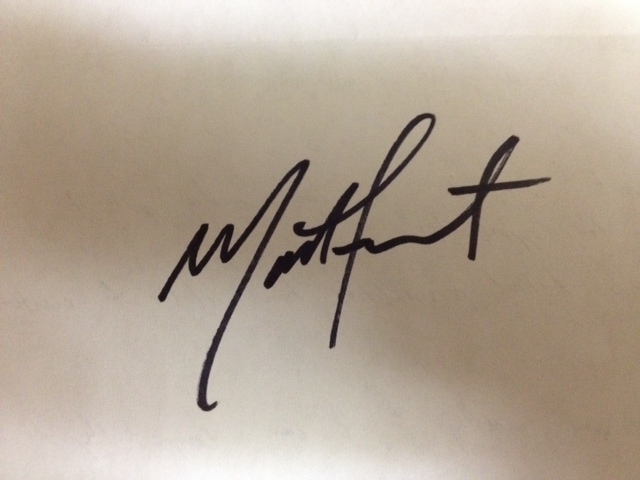
I used to practice my signature. Every day in ninth grade Spanish class, when I entertained thoughts that my baseball skills would get me to the bigs, I worked on making my signature visible so that when it was on a baseball along with many other scribbles, people would notice and say "That's Matt Hurst." I did it because I had seen too many baseball players scribble their names in illegible forms. I wanted mine to be recognized by the kids who had asked.

The final stroke on the M in my first name dangles like the state of Florida, as does the final line of the H in my last name. All those days not learning how to ask where the bathroom is has given me a distinct scribble.

When UC Santa Barbara alum Jim Rome came to campus to speak in his first appearance back at the school since he graduated, I was asked to be on stage with him and moderate his Q&A session. 
Rappin' with Rome.

Afterwards, when many people were asking to take pictures with him and his associates, one person came up to me and asked for a picture and a scribble.

"I'm not really associated with Jim," I told the person, trying to explain that as an alum and one of the school's broadcasters, I seemed a good choice to the decision-makers to be on stage with him.

He said he wanted to have memories of anyone with Jim Rome that night. So, I signed.

I always feel bad giving someone my scribble because one day they're going to look at it and go "What the hell?" and throw it out. That doesn't bother me. I just feel like I'm wasting someone else's time.

My favorite Scribble Story, though, comes from a mistaken identity.

I had shared a cab with three other Angels writers to the player's entrance at Great American Ballpark in Cincinnati and across the street were Scribble Seekers. Guys with their baseball card books in one hand, a Sharpie in another, constantly flipping through their sets of cards trying to match a pictured face with a real-life one.

The other writers emerged from the cab and, like many other stereotypical baseball writers, they weren't in terrific shape and a little bit older than the subjects they were covering.

When I popped out of the cab, the Scribble Seekers came running over, dodging traffic to get to me. Again, as a mid-twentysomething in decent enough shape and walking in and out of ballparks at the security entrances, people assumed I was worth a scribble.

When the Seekers approached, they saw that I wasn't a ballplayer. That my bag was not filled with hats or gloves or bats and balls. It had a laptop and pens.

The disappointment on their faces was sad, but completely priceless.

If I was ever worth a scribble, I'd always be happy to take the time and sign. I just don't feel I'm worth the effort, even if others think so.

However, there is one place I'm happy my name has been scribbled.

Inside the Green Monster at Fenway Park, I carved my name, making sure my scribble wasn't in chalk and therefore could easily be cleaned up when they wiped away the scribbles every year.

My scribble lives on in America's Most Beloved Ballpark. 


Monday, July 2, 2012

Sports metaphors to explain dating and sex


-- by Josh and Matt

You don’t need to like sports to enjoy sports metaphors.

When a politician finishes a speech or a debate, the staff will often claim their boss “hit a home run.” How often do you hear the phrase “game over” to explain situations that don’t involve games?

Even if you don’t like baseball, and even if definitions are slightly different, you understand the jist of “getting to first base” or “getting to second base” in the mating dance.

To “spit game” you need not be involved in an organized game. Of course, dating is a game and sometimes you have to “play the game.”

In the naming game for dating and mating, the options are endless with sports metaphors.


Many are obvious. We all know a “slam dunk” is when the girl is clearly into the guy. Maybe it’s a slam dunk she’ll allow you to “get to third base” or maybe it’s a slam dunk she will “pull the goalie.”

While we know what those mean, there are many other euphemisms for extracurricular activities that are derived from extracurricular activities.

Since we’re both men, our guide to sports metaphors for dating, sex and relationships comes from the male perspective:

Baseball
·         Ground-rule double: When you can only get to second base with a woman because "it's that time of the month." You have to stop at second base.

·         Striking out the side:getting three different numbers the same night. 

·         Triple crown: having sex with three different girls the same day.

·         Grand slam: having sex with a woman before dinner, after dinner, the next morning, then after breakfast again.

·         Taking a 3-1 fastball:not realizing a woman is really into you. 

·         Pitching around somebody:blowing off a chick who wants you because you want her friend. 

·         Double play: having sex with two women at the same time. A three-some.

·         Triple play: having sex with three women at the same time. A four-some.

·         Broken bat: when you’re trying to open a condom package, and in the process, you tear the condom.

·         Striking out looking: when a woman is making eyes at you from across the bar, or any social setting, but you never approach her.

·         Striking out swinging: when you keep trying, and trying, and trying, but do not “score” a phone number or kiss or anything else.

Basketball
·         Full-court press: putting on a very strong advance in approaching a mate, or a first date. Going to the full-court press can lead to that first date, or turning someone off. You have to choose when to employ it or else you can get burned.

·         The lay-up: A gimme, a simple feat. It could be a loose woman in public, or the ease at getting a phone number.

·         Posting up: When a girl is standing at the bar, and you’re angling your body in a way that no other guys can come close to talking with her.

·         Man-to-man: when a group of guys and girls are talking in a bar, and you’re able to break away from your respective friends to talk alone.

·         Buzzer beater: going home with a girl you meet at 1:59 am. 

·         Making a full court shot:walking up to a girl you’ve never met, telling her your favorite ridiculous line that is code for having sex immediately, and she somehow says yes.

Football
·         Hail Mary: Hitting on anything and everything after 1:30 am.

·         Pic six: when a girl is about to go home with another guy, then abruptly changes her mind and goes home with you instead. 

·         Field goal: when it’s clear you’re not going to have sex, and you settle for a blowjob. 

·         False start: putting your hand on a girl’s ass, and she moves it away.


Off Sides: trying to convert a female friend into a girlfriend and she's not down with that.

Out Kick Your Coverage: you're dating someone who is way too hot for you.

·         Giving the Heisman:when a girl is cute and interested in you, but you can’t deal with her because she’s so overwhelmingly drunk, so you keep her at arm’s length.

·         Gatorade shower: making a woman squirt. 

·         Clearing some cap room: deleting old girlfriends’ numbers from your phone.

·         Stealing signs: when playing wingman for a friend, you ask questions to help your friend, then you use that knowledge to try hooking up with her yourself. 

·         Successful two-point conversion:when she gives you a clean-up blowjob after you just had sex. 

·         Failed two-point conversion: when you attempt the post-sex blowjob, and she rolls away in disgust.

·         Red zone defense: when you’re not having sex because it’s that time of the month.

Hockey
·         Pulling the goalie: when the woman takes off her panties … or when she goes off birth control. Depends how long you’ve known her, and the purpose of this game.

·         Power play: Used when the charisma of a group makes you look better, and you’re able to score a phone number. You relied on the strength in numbers.

·         Icing: we still don’t know what it means in hockey, so we don’t know what it means in the dating game either.

MMA
·         Tap out: When you’re talking to a girl, she’s not buying your game at all, so you just abruptly leave.

Tennis
·         Double fault: When you return an hour later, and still make no progress.

·         Ace is having sex on first date. 

Soccer
·         Direct kick: when a girl approaches you in a bar and starts a conversation. It’s not a guarantee that you’re going to score, but you’re in a whole lot better position.
·        
      Converting the penalty kick:when the girl says, “let's go back to your place” and you have sex. 

·         Missing the penalty kick:when the girl says, “let’s go back to your place,” and you don't have sex.
This guy clearly missed the penalty kick.

·        Own goal: When you can’t make your female partner orgasm, so she does it to herself. 

Golf
·         Hole-in-one: Getting your wife pregnant the first day she goes off birth control and you don’t use a condom.


Bowling
·         Pick up the spare: When you strike out on the hot chick, and hook up with her not-so-hot friend.

There’s our list. Agree or disagree? Want to add your favorite sports metaphor? Leave a comment at the bottom.