Wednesday, June 13, 2012
Podcast: A divided Bay over San Jose
In the latest Out of Ink podcast, Josh and Matt discuss the fight over territorial rights in San Jose. The Oakland Athletics want to move to San Jose. The San Francisco Giants own the territorial rights and are blocking them. Commissioner Bud Selig has waited over three years, yet still hasn't made a ruling. Josh wrote about this topic before, and now the duo discusses it.

Tuesday, June 12, 2012
Sharpie Scribbles – chapter VI, Benito Santiago
--by Josh Suchon
Note to readers: The feedback on the “You Were Lucky, Hershiser” story was so positive, and triggered so many memories from a childhood where my playground was the Oakland Coliseum, I’ve decided to share more of these stories. I’m blatantly stealing this idea from “Cardboard Gods” author Josh Wilker, who used his baseball card collection to tell the story of his childhood in the 1970s. Wilker gave me his blessing, so I’m going to use my autograph collection to tell the story of my childhood in the 1980s.

When spring training 1989 arrived, I was ready to dominate the autograph scene. It was my third year collecting Sharpie Scribbles, my second year going to Arizona. I knew where to go, when to be there, what to say, what pens to use, and how to be ready.
Without question, that was the best week of autograph collecting in my life. Can’t remember the exact number, but 223 is what sticks in my head. Not a bad haul for a nine days.
I did have some help from family and friends.
My dad took the week off work, and we went to Arizona together. Our routine was simple. He’d drop me off at the ballpark between 8-9 am. I’d get Sharpie Scribbles all morning, while he went back to the hotel to sleep or check in at the office. He’d arrive around game time. We’d watch the game together, stick around a little later for a few more autographs, then go find a place to eat and watch the NCAA Tournament games.
My friend Chris Poulson was a batboy for the A’s at that time. He happened to be in Arizona that same week. Before one game, Chris found me in the stands and said the A’s needed a batboy for the day. The next day, he said the visiting Padres needed a batboy.
Both were great thrills. The more memorable was the day with the Padres. I had a chair next to the on-deck circle. I wouldn’t say anything to the players, unless they initiated the conversation. I remember some fans in the first row were chatting up Benito Santiago, and he was in a good mood.
In his first at-bat, Santiago hit a home run. In his second at-bat, he hit another home run. Both times, I was waiting at home plate with his bat in my left hand, and my right hand extended into the air. When he crossed the plate, Santiago gave me a high-five. Oh man, that was so cool.
I wasn’t a Padres fan, but I’d always liked Santiago. He was the Rookie of the Year in 1987, had that long hitting streak, threw out base runners from his knees, and I thought Benito was a cool unique name. Now, I was a huge fan of his.

In the last inning or two, a minor league catcher who was on a lot of those “future stars” baseball cards also homered. And just like with Santiago, I gave Sandy Alomar, Jr. a high five at home plate after his home run. Now, I was a huge fan of Sandy, his brother Roberto, and their dad.
Millions of other kids were stuck in classrooms around the country. I was in the Arizona sun, getting autographs, chasing home run balls, and high fiving Padres catchers after they hit home runs.
After the game, I was in the Padres tiny clubhouse – and unlike a year earlier at the Coliseum, when my friend raided Jose Canseco’s locker illegally, I was allowed in there. I could ask any player for his autograph, and had no competition. It’s an unwritten rule that players always sign autographs for the spring training batboy that was pulled from the stands. It’s like your paycheck.
For some reason, I didn’t stick around too long. Don’t ask me why I didn’t go from player to player. It was probably because I’d already gotten everybody’s autograph that I wanted earlier in the day. By the end of the game, most of the players were gone. There were only two players that I wanted to get: Tony Gwynn and Benito Santiago.
Gwynn signed my 8x10 photo, and it’s one of the most beautiful autographs in my collection. I could tell he was taking his time, making sure all the letters were neatly written. This wasn’t a scribble. This was a signature. When I got home, I bought a frame and proudly put it on my bedroom wall. This was the first of hundreds of interactions with Gwynn -- as a kid, and later as a reporter -- and all of them were positive.
 |
| T-Gwynn took his time, and this one's beautiful. |
I didn’t have an 8x10 photo for Santiago to sign that day. But he did sign a baseball card for me and I remember we chatted about something. I’m sure it was something about his home runs. A couple more times over the years, I got Santiago’s autograph again, including on an 8x10 photo.
When I came back to school after my week in Arizona, I had lots of stories to share. All the girls wanted to know how I was so tan. All the boys wanted to know how I was a batboy.
***
The last week of spring training in 2001, my second as the Giants beat writer for The Oakland Tribune, the Giants signed Benito Santiago as a free agent.
This news was a godsend to the reporters covering the team. By the last week, you’re out of feature ideas, you’re sick of watching exhibition games, you just want to go home, and the only news items are the battles for the final reserve spots on the roster. The arrival of Santiago gave us all new storylines to pursue the final week.
I’d talked to Santiago and asked questions in the group interviews, but didn’t mention the batboy story. A few days later, when nobody else was around, I went over to Santiago’s locker and told him the story about the two home runs and the high fives.
“So you’re my good-luck charm, huh?” said Santiago.
***
It didn’t start right away. But at some point, I think it was actually the next year, Santiago started referring to me as “my favorite reporter.”
Truth be told, Santiago was my second favorite person in the Giants clubhouse during the four years I covered the team from 2000-2003. Shawon Dunston was my all-time favorite. Santiago was second. Rich Aurilia was third.
Santiago ran hot-and-cold as an interview subject. Most of the time, he was great to all reporters. Sometimes, he got in these bad moods, blew off crowds of reporters, and could be difficult.
But he was always good to me. A few times, he went out of his way to say, “I’m only talking to my favorite reporter.” I found it hilarious, embarrassing, and empowering all at the same time.
On the night of Sept. 11, 2002, my sports editor called me with bad news. I was supposed to leave the next morning to cover the Giants two-game series in San Diego. But another round of budget cuts was bleeding into the Trib’s sports travel budget, and the bean counters decided they wanted to save two hotel nights, two days of per diem, and a rental car.
The rest of the conversation went something like this:
Me: “The plane ticket isn’t refundable. We’re going to eat it.”
Sports Editor: “If you still want to go, you can use the plane ticket. We just can’t pay anything else.”
Me: “If I’m paying my own way, I’m not writing for the paper. These are days off. I just happen to be taking them in San Diego.”
Sports Editor: “That’s fine with me.”
***
The next morning, I used the flight to San Diego. Instead of working, I spent all day at the beach with my college friends. Sometime around noon, I missed a call from Josh Rawitch, who was then covering the Giants for mlb.com, and listened to his message about grabbing lunch or something.
I realized that he didn’t know, and none of the other reporters knew, that I wasn’t covering that series due to budget cuts. With perhaps a couple adult cocktails already in me, I realized the stage was set to pull the ultimate practical joke on my colleagues.
Around 2 or 2:30 pm, I called Rawitch back. I told him I was hanging with my friends at the beach, would be heading to the ballpark soon, and would see him there.
Of course, I never showed up at the ballpark.
As the day went on, the concern grew, especially as I missed the clubhouse getting opened, then the daily pre-game session with manager Dusty Baker, then all of batting practice, and then even the first pitch.
Matt Hodson was the Giants public relations official on the trip. It was his second road trip. On the first, Barry Bonds and Jeff Kent got into a dugout fight. On his second, one of the team’s traveling beat writers was now missing under his watch.
My phone rang with calls. It buzzed with text messages. I ignored them all. I laughed, perhaps downed another adult cocktail or two, and let their imaginations run wild.
***
Around the second inning, after perhaps another adult beverage or two, I enlisted the help of my college friend Ferris. He used my cell phone to call Josh Rawitch. The conversation went something like this:
Ferris: “let Soooosh know that he left his cell phone at the bar. But don’t worry, I’ve got it.”
Rawitch: “Soooosh isn’t here. Where the hell is he?”
Ferris: “What do you mean he’s not there? Where is he?”
Rawitch: “We’ve been trying to figure that out. We’re calling the police to see if something happened to him.”
Ferris: “The last time I saw him, he was talking to these two girls at the bar.”
***
Around the fifth inning, after perhaps another adult beverage or two, I called Rawitch. The conversation went something like this:
Rawitch: “Where the hell are you?”
Me: “Dude, you won’t believe my day.”
Rawitch: “What’s going on? Are you OK?”
Me: “Yeah, I’m OK. Meet me at [some bar I can’t remember] bar after the game. I’ll explain everything. Oh crap, the police are back. I have to talk with them again. Meet me at the bar.”
***
By the time the game ended and Rawitch finished filing his stories, I might have enjoyed another adult beverage or two. It was close to midnight. Rawitch and Hodson arrived at the bar, glad to see that I was OK, and curious just what the hell happened to me.
There’s no way that I can do justice to the story that I told them. I do know that it involved the story Ferris told about last seeing me with two girls at a bar. I was making this up on the fly, when suddenly Ferris blurted out, “tell them the part about Benito Santiago!”
Rawitch and Hodson to me: “What?!?”
Me glaring at Ferris: “I told you not to bring up Benito’s name. He stays out of this.”
I stormed off to the other side of the bar, in mock anger. In reality, I was trying to figure out a way to weave Benito Santiago into this ridiculous story that I was telling. A minute or so later, I came back to the group.
Again, there’s no way that I can do justice to the story I told them. I do know that it involved how Benito always referred to me as “my favorite reporter” and how he would set me up with some of his leftover groupies on the road, especially in a city like San Diego, where he used to play.
I’ll never forget the way Hodson stood there: his mouth wide open, not saying a word, not drinking, stunned, speechless.
Toward the end of this ridiculous story, I said something along these lines: “you know guys, tonight has really made me think about the decisions I make and my priorities. This is really a wake-up call. But I must say, that when it’s all said and done, the one thing that I can count on … is that you two idiots will believe anything I say.”
At the point, Rawitch and Hodson began punching me, and calling me every name you can imagine. I deserved every punch and every insult. I finally told them the truth. I wasn’t working because my newspaper is incredibly cheap. I used a free flight down here though. I was having fun with my college friends.
They hated me even more.
***
About a week later, I was back on the company’s dime and covering road games. Well, somewhat. I was told that I should cover the four games in Los Angeles, but miss the three games in Milwaukee.
At that time, Benito Santiago had been suspended two games after getting ejected from a recent game and umping umpire Mark Hirschbeck. Santiago was appealing the suspension. All the reporters were trying to figure out when Santiago would drop the appeal.
 |
| This ejection led to Benito giving me a scoop. |
Toward the end of batting practice, I walked back through the visitor’s clubhouse on my way to the Dodger Stadium press box. Santiago was at his locker. The conversation went something like this:
Me: “Benny, are you dropping the suspension tomorrow in Milwaukee?”
Santiago looked around, and saw that nobody else could hear. “Yes, but I’m only telling my favorite reporter.”
This was the pre-Twitter days. If it was 2012, I’d have probably put the news on Twitter. The ‘scoop’ would have lasted all of five minutes. All the reporters would have included it in the newspaper the next day, or their online stories that night.
But in 2002, it was saved for the next day’s newspaper as the lead item in my notebook. None of the other reporters had the story.
I was back in the Bay Area the next day, when Henry Schulman of the San Francisco Chronicle called me from Milwaukee.
“How the hell did you scoop us when you’re not even here?”
I just laughed and told him I got lucky.
It was a long story.
It went back to spring training in 1989, when I was 15 years old, and got pulled out of the stands to be the Padres batboy.
Tuesday, June 5, 2012
Sharpie Scribbles -- Chapter V, the 1988 Olympic team
-- by Josh Suchon
Note to readers: The feedback on the “You Were Lucky, Hershiser” story was so positive, and triggered so many memories from a childhood where my playground was the Oakland Coliseum, I’ve decided to share more of these stories. I’m blatantly stealing this idea from “Cardboard Gods” author Josh Wilker, who used his baseball card collection to tell the story of his childhood in the 1970s. Wilker gave me his blessing, so I’m going to use my autograph collection to tell the story of my childhood in the 1980s.

To say that I was obsessed with the 1988 Olympic baseball team is a massive understatement.
The summer of 1988 was the peak of my Sharpie-Scribbling, Ball-Chasing, Game-Watching existence. I went to 53 A’s games that year. From the time my freshman year in high school ended in June, until my sophomore year started in September, I only missed two games – and that’s because I was in Reno with my mom and sister to celebrate our birthdays.
 The stars of the 1984 Olympic baseball team – Mark McGwire, Will Clark, Barry Larkin, Cory Snyder, B.J Surhoff, Bill Swift, Bobby Witt – were established in the big leagues by 1988. I recall reunions of that team at massive baseball card shows, which were exploding in popularity.
I’d already snagged most of those players’ autographs at the ballpark, so I didn’t wait in the lines and pay the money. But one of my favorite purchases was an official baseball from the 1984 games in Los Angeles.
So when the 1988 Seoul Olympics arrived, I was ready for the next generation of American heroes that would become major league stars. And when I say ready, I mean ready to buy anything that had their name on it, and ready to hound them for Sharpie Scribbles.
 It wasn’t easy to find information or watch that team. Baseball was only a “demonstration” sport. Pretty sure not a single game was on TV. This is when NBC only had one network to show events. There were some highlights on NBC’s coverage, but you’d have to scour the agate of newspapers, and hunt for little nuggets from Sports Illustrated and The Sporting News.
 Team USA won the gold medal at those games. Jim Abbott went the distance in the championship game victory over Japan. All the baseball card companies would follow Topps’ lead from 1985, and put those Olympic players all over their sets in 1989.
It wasn’t enough for me to buy those Topps, Bowman and Upper Deck cards. I found myself buying the “rookie” minor league card for those players too.
 In the case of Robin Ventura (Birmingham Barons), Tino Martinez (Williamsport Bills), Ed Sprague (Dunedin Blue Jays) and Charles Nagy (Kinston Indians), they were smart purchases.
In the case of a few others, it was an utter waste of money. That’s why I still have in binders the 1989 team sets of the Springfield Cardinals (Mike Fiore), Peoria Chiefs (Ty Griffin), Osceola Astros (Scott Servais and Dave Silvestri), Shreveport Captains (Ted Wood), Cedar Rapids Reds (Jeff Branson) and San Bernardino Spirit (Jim Campanis).
The most disappointing flameout was Griffin. I had big hopes for him. So did the Cubs. They drafted him with the ninth overall pick in 1988. The plan was for Griffin to take over at second base, so Ryne Sandberg could move to third base. Griffin blistered the competition for the USA national team, posting a .416/.485/.805 slash line, plus 21 steals.
I bought two 8x10 photos, a lot of his rookie cards, and even some minor league cards. One year in spring training, I went to the Cubs minor league fields to look for Griffin. Nobody else was there looking for autographs. I found Griffin and got a signature on his Olympic card. He was destined for greatness, I thought for sure.

That was a miss. Others were big hits.
Everybody knew Ventura would be a star. He had that 58-game hitting streak at Oklahoma State, made his big league debut a year after the Olympics, and was a regular in 1990.
Ventura made an appearance at a baseball card show in San Francisco in the 1990-91 offseason. My good friend Jeff Coulthart and I bought a dealer’s table at that show to sell cards.
 It wasn’t my style to pay for autographs, but I made an exception for Ventura with three specific items – his minor league card, his Olympic card, and in the sweet spot of an (almost) shiny white ball that I got one day at during batting practice.
Immediately, I placed them in a Ball & Card Display, which I shortened to BCF for Ball Card Frame. I was all about the BCF’s, especially for that Olympic team.
In spring training, I got Andy Benes and Abbott’s autographs on those Olympic cards and the sweet spot of a ball. More BCF’s were purchased. The shelves of my bedroom became a shrine to that Olympic team.
Usually, anything was fair game for an autograph. I made a rare exception for a rare 1987 Olympic team item. Yes, 1987, the year before the Olympics.
It’s a team set produced by the United State Baseball Federation. Most of those players went on to play in the Seoul Olympics, but a few didn’t. To this day, I’ve still never opened the packaging to look at any of the cards. The only card I’ve ever seen is the pitcher Abbott, who is showed with a bat in hand.
The back of the packaging shows the checklist, which includes Frank Thomas, Gregg Olson, Cris Carpenter and Pat Combs.
The name Pat Combs means nothing to you. But for reasons that I can’t fathom to this day, I was totally obsessed with Pat Combs. I must have 10 of his minor league cards and 20 of his rookie major league cards. A lot of good those purchases did me.
 Olson is interesting to note. Once I learned he was on the USA training team, I started purchasing more of his items, and added him to my BCF wish list. When I took the photo a few nights ago of what remains of my batting practice ball collection, I saw Olson’s signature on a ball in the sweet spot and in a protective case mixed in.
Not sure what happened to the autographed card, or the rest of that BCF frame. Just like I’m not sure what happened to Olson’s once promising career. I guess they both got injured somewhere along the way. But I do have Olson’s signature preserved on an 8x10 photo. I remember exactly where I got it: the parking lot of the Oakland Hyatt hotel, before he went across the freeway to the Coliseum.
***
In 2000, my first year covering the Giants for The Oakland Tribune, their top prospect in training camp was a kid named Kurt Ainsworth. He was a first-round pick, made a solid pro debut, and his appearance in training camp warranted an early feature story.
That September, Ainsworth was chosen for the USA National Team that went to the Sydney Olympics. Ainsworth was the starting pitcher for a couple victories in those games. Ben Sheets won the Gold Medal game over Cuba, and those players came back home heroes.
A few of my colleagues, especially Mark Saxon, accused me of writing too much about Ainsworth and having a man-crush on him. I tried to justify it by saying what a top prospect he was for the organization, and what else was there to say about Russ Ortiz and Kirk Rueter?
In retrospect, Saxon probably was right. The number of stories and notes on Ainsworth probably was overkill. Upon reflection, maybe I’ve never got over my obsession with USA Olympic Baseball teams.
***
In 2008, a few weeks before I moved from Modesto to Los Angeles to take the job as the reporter for the Dodgers Radio Network and the co-host of PostGame Dodger Talk, I attended a fundraiser for the University of the Pacific baseball team in Stockton.
 Ed Sprague, a Stockton native, was the Pacific head coach. He invited his friend and old Olympic teammate, Jim Abbott, to be the keynote speaker. Abbott is an incredible speaker, and the audience was enraptured by the story of his no-hitter, and how he was shelled the start before that no-hitter.
For me, the best part of the night was the stories that Sprague and Abbott told about that Olympic Team, and winning the gold medal in Seoul. As I listened, I was a 15-year-old kid again.
Before leaving for that banquet, I thought about digging through my trunk of childhood memories, finding the items left from my Olympic collection that still needed to be signed, and buying a fresh new Sharpie to get a couple new scribbles.
In the end, I decided against it. Autographs were my childhood addiction.
Now, I’m content with a free banquet meal … and a chapter for the Sharpie Scribbles.
Monday, June 4, 2012
Gays in Sports: A Decade Later
-- by Matt Hurst
I realized early in my journalism career that game recaps and cheery feature stories weren't the best way to build up my clips package. As I aimed to work at bigger newspapers, I had to tackle bigger issues. Therefore, I had to write bigger stories that would challenge my writing, my reporting and my comfort level asking tough questions.
My first job out of college found me working at a small paper - the Vallejo Times-Herald - and allowed me to work on these aspects whereas if I had started as an intern at, say, the Los Angeles Daily News, I wouldn't have been allowed to explore these stories, let alone ask any editors for their approval when I pitched them.
My sports editor at the 25,000 circulation looked at me sideways when I mentioned my idea: a story about why the public did not know any homosexual athletes in major professional team sports.
"You sure you want to do that?" he said.
I nodded. It wasn't just for my clips. It was a story I wanted to dig in to.

(Tangent: It's a story I'm still interested in as Josh and I discussed in our latest podcast. I find it fascinating that as a population, we are worried about homosexuals and that our backwards American values prevent the majority of the population from accepting it. As some comedian once said "If gays want to get married, let them. They can miserable just like every other married couple." I also chuckle at the thought that Mike Piazza held a news conference to tell everyone he was not gay.)
***
It was the back story that interested me the most.
As the Editor-in-Chief of a left-thinking college newspaper at a left-thinking university (are there any right-thinking universities?) I was faced with overseeing almost-daily social acts from various groups around campus. I had gotten to know Harley Augustino on a somewhat friendly basis because he always seemed to be involved in every active party.
He was marching with gays. He was protesting an Oliver North appearance. Despite being white, he was out front with several ethnic groups.
I learned, from a mutual friend, that Harley was an exceptional athlete in high school. I was pretty good myself, but not good enough to play in college. Yet, I played in a weekly baseball league that would include our university's Division I players during the summer, as well as any local D-I guys who returned home. It wasn't your typical beer league, let's put it that way.
One day, Harley asked me about it and I told him we needed another player, specifically a pitcher. He said he could pitch a little.
What a liar.
He fired bullets to me all day. His curveball was so devastating I had trouble catching it. We won in a romp and Harley befuddled the other team all day. He was the best pitcher I ever caught and I was glad I didn't have to face him.
I knew not to ask him about why he wasn't pitching for UC Santa Barbara. Our mutual friend had already told me why.
Harley didn't play because of the atmosphere around baseball locker rooms.

***
When I worked on the story in the winter of 2002, Harley was the last person I called.
I wanted to get as much information as possible from everyone else before I called him. I spoke with Vallejo-area high school coaches and athletes and the coup de grace - in my mind - was when I spoke with Andre Carter of the San Francisco 49ers and Lincoln Kennedy of the Oakland Raiders. Both were completely honest and Carter basically said what people do behind closed doors doesn't bother him while Kennedy said it wouldn't work for homosexuals to come out since there was too much homophobia "across the league."
I can't believe, how in 2002, a lot of people were saying the same things they are now saying a decade later. It's incredible to think there has been no change on this front, yet so many other things have happened (the Internet explosion, social media, a black President, the Red Sox winning two World Series).
It was Harley's interview that really helped the story. He was happy to speak about it openly, on the record, and didn't pull punches. It was exactly how he was when I knew him at UCSB. And, it was his final quote in my story that I still think about whenever this subject arises.
"I think you have a lot of closeted players out there, who either love the game so much they are willing to put up with it and lead a double life, which is taxing for people. There are a lot of athletes who don't go in that direction because of that.
"Maybe because of homophobia we are losing some great athletes."
To read the entire story I wrote 10 years ago, it follows after the jump


Sharpie Scribbles -- Chapter IV, Dave Henderson
--by Josh Suchon
Note to readers: The feedback on the “You Were Lucky, Hershiser” story was so positive, and triggered so many memories from a childhood where my playground was the Oakland Coliseum, I’ve decided to share more of these stories. I’m blatantly stealing this idea from “Cardboard Gods” author Josh Wilker, who used his baseball card collection to tell the story of his childhood in the 1970s. Wilker gave me his blessing, so I’m going to use my autograph collection to tell the story of my childhood in the 1980s.

When I reflect on my childhood experiences with Dave Henderson, the following items come to mind first:
1, Hendu often wore all-white jump suits and was totally paranoid that our Sharpies would get on his clothing when he stopped to sign autographs in the player parking lot.
2, Hendu had not one, but two fan clubs in the Coliseum bleachers. “Hendu-land” was the last section of bleachers in left-center before the batter’s eye. “Hendu’s Bad Boy Club” was in right-center, a section without stairs going down because the batting cage was below.
3, Hendu had a gap between his front teeth, on display whenever he flashed that awesomely goofy grin. He flashed that grin when he signed my “One Strike from Boston victory” 1987 Fleer card, and somebody asked him about those playoffs.
 4, Hendu’s performance in 1988 made me forget about the departure of Dwayne Murphy, one of my favorites and the last remaining member of the A’s 1981 playoff team.
5, Hendu coined the term “Fly Boys” for the two biggest legends in the bleachers.
Mike Kelly and Jay Didier were rock stars among the regulars who showed up for autographs, chased batting practice home runs, cheered on the A’s from the bleachers, stuck around postgame for more autographs, then did it all over again the next day.
Their rock-star status, at least to me, was based on their ability to fly down the stairs. Yes, fly.
They put the open side of their gloves on the railing, bent their elbow so it was pointed down, leaned in, reached back with their bare right hand further up on the railing, and slid down -- knees bent, feet in the air, hair flying.
Their feet never touched the steps. They were a blur. They were down the steps so much faster than everybody else, they’d get just about any ball that didn’t land in the seats.
In my last posting about Curt Young and Rick Honeycutt, I wrote about how Didier was an older guru. You listened to Didier.
You idolized Kelly. He invented the sliding down the railing technique, and was clearly the best. He was a few years older than me, and was an incredible athlete. I once played catch with him in the parking lot – between autograph time, and BP time, you had to get your arm loose – and couldn’t believe his arm.
Mike Kelly was like Kelly Leak from the Bad News Bears. Kelly even had long hair, like the fictional Kelly.
I wanted to be like Mike.
I wanted to glide down those railings, using just my glove, my feet never touching the steps, hit the ground, find the ball in the air, run underneath it, and catch home runs on the fly. I wanted kids a few years younger than me to idolize me and ask me to show them how I flew down the railing like that.
I went to my high school on weekends – you know, so nobody would see me looking like an idiot -- and practiced trying to slide down railings with my glove.
Try as I might, I couldn’t do it. Couldn’t generate the balance. Couldn’t generate the speed. Couldn’t generate the courage to go that fast, and trust myself that I wouldn’t do a face-plant. I even tried to lather up my glove with oil for better sliding. It didn’t work.
Best I could do is run down about two-thirds of the way, and somewhat slide down the last 4-5 steps. In reality, it was more like me jumping down the last steps than gliding down on a glove.

Kelly and Didier were among a group of about 20 that sat in the same bleacher section each game: second section over from the steps in left field. When the A’s reached the playoffs in 1988, the group didn’t have access to playoff tickets because they weren’t official season-ticket holders, even though they went to every game. The bleachers were sold day-of-game only.
That group wrote a letter to then-A’s owner Walter Haas, explaining their situation and asking for assistance. Not only did Haas make sure they were in the Coliseum for every playoff game, he made sure they were seated in their section and in the first two rows – their usual spot. (Another reason Haas was such a beautiful man and owner.)
This meant Kelly was in the front row, aisle seat, closest to the railing. Didier was next to him.
In Game Three of the 1988 American League Championship Series against the Red Sox, Kelly accomplished something that I have no way to prove is true, but I can’t imagine anybody else has ever equaled: catch three home runs in a single playoff game.
Mark McGwire, Carney Lansford and Hendu hit home runs over the left field wall in about the same area. Kelly, flying down the railing, way before everybody else, ended up with all three. (Ron Hassey, a lefty, pulled his home run to right field.)
I didn’t have tickets for that game. I remember watching it on TV with my dad, seeing the blur that is Kelly flying down the stairs, and thinking, “I bet Mike ended up with all those home runs.”
When I got to the Coliseum the next day for Game Four, my guess was accurate. He got ’em all. Each ball was secured in a separate plastic bag with all the details, and he was trying to get them autographed, just like he did with all his home run balls. The dude was incredible.
Watching Kelly was awesome, yet utterly intimidating. You had so few chances to get home runs -- in batting practice or the game -- because he got so many. And if Kelly didn’t get it, Didier would. You had to pick another section to patrol, but their section was the prime real estate.
My seats varied at the Coliseum. My dad bought 20 games annually from his friend and the seats were incredible -- section 123, row 2, aisle seat 13 and 12 -- just one section over from the A’s dugout.
For the other 20-35 games I would attend with my friends, we’d buy the cheapest seats and bounce around. I loved the first row of the second deck, right behind home plate, for the view of the field and the chance to get foul balls. Another favorite spot was down the left-field line, near the A’s bullpen. We ended up in the bleachers quite a bit too.
I still ended up with about 25 major league balls over a four-year period. By comparison, 25 balls was probably a home stand for Kelly. If the baseball was a brand-new white “pearl,” I’d use it to get autographs. The best part of getting a ball was actually bringing it to Little League practice, asking if somebody wanted to play catch, and waiting for them to notice what kind of ball we were using.
All the baseballs that I obtained were during batting practice. Much to my dismay, I never caught a home run ball.
On opening day 1989, I thought for sure I had my first. My friends and I sat two sections over from The Fly Boys, so we could be in the front row too, and have a better chance.
Facing Dave Stewart in his first major league at-bat, Ken Griffey, Jr. ripped a ball into the left-center gap. Off the bat, I saw it coming right toward us. Without hesitation, I sprinted down the steps, head down so I wouldn’t trip, jumped the last few steps, hit the ground, and realized that I was ahead of everybody. This historic ball would be mine for sure.

Then I realized why I was alone down there. The ball didn’t go over the fence. It one-hopped the wall. It was only a double. When I came back up the stairs, I was mocked for thinking the ball was gone. I couldn’t help it. If I was going to beat “The Fly Boys” for a ball, I had to run before I could judge if the ball was gone or not.
Mike Kelly and Jay Didier were everywhere. I went to spring training with my Dad, and who did I see there? Mike and Jay.
It seemed like Kelly always had the best 8x10 photos to get signed. You’d usually see the same photos at card shows, but Kelly had photos that I never saw anywhere else. I asked him one day where he gets them, and he told me about a store along the Peninsula, close to where he lived.
By then, my friend Todd Strong had his driver’s license, so we made our way to the store. The selection was heaven. They had 8x10 photos of the stars, the top prospects, and the most random players. They had 8x10 photos of practically every A’s player, including Hendu, so I bought one and got it signed.
Going through the photo binders one day, I did a double-take at the background of an 8x10 Jeffrey Leonard photo. A lot of those photos were taken in spring training. I recognized the Mariners old field in Tempe, and recognized the guy in the background with his shirt off and wrapped around his head.
It was Mike Kelly.
He was everywhere.
 |
| That's Mike Kelly under Leonard's arms. |
***
Mark Saxon was the A’s beat writer for The Oakland Tribune from 2000-03. I was the Giants beat writer those four years. Saxon took a job with The Orange County Register after the 2003 season, and I was given the choice of whether to continue covering the Giants or switch to the A’s.
The Giants are the bigger story in the Bay Area by a longshot, but the A’s mean more to The Oakland Tribune. It was a guarantee I’d be above the fold on the front page of the sports section every day. The A’s still had Tim Hudson, Mark Mulder and Barry Zito for star power, and I could get away from the circus of covering Barry Bonds every day. The decision was a no-brainer.
Besides, after all those years getting Sharpie Scribbles at the Coliseum, telling World Series heroes they were lucky, chasing Jose Canseco around the parking lot, and having a man-crush (before I knew what a man-crush was) on some dude who slid down the railing named Mike Kelly, it was time to come full-circle and cover the A’s.
The Coliseum, as my work place, was much different than the Coliseum as my childhood playground.
The renovations to accommodate the Raiders ruined the bleachers. They were never the same. Most of the characters from those days stopped going to games, or sat somewhere else. Still, every day when I was on the field during batting practice, I’d look into the crowd and wonder if I’d ever see Mike Kelly or Jay Didier again.
For four years of my childhood, they were everywhere.
Now, they were gone.
As I’ve mentioned before, I didn’t talk about my childhood at the Coliseum very often with work colleagues. I’m sure they didn’t care, I didn’t want them to think I was some closet A’s homer who wasn’t objective, and it’s somewhat embarrassing what a baseball nerd I was back then.
One night though, I think at a bar in Kansas City over multiple vodka and red bulls, I was out with one of the guys from the A’s television crew named David Feldman. The conversation turned to the Coliseum bleachers in the late 1980s. Turns out, he always sat in the same bleacher section with Mike Kelly and Jay Didier.
Feldman didn’t know where the “Fly Boys” are now, but he knew them well back in the day.
We didn’t know each other in the 1980s, mostly because Feldman wasn’t into getting autographs, but we knew many of the same Coliseum Characters, and we’d spent countless nights sitting very close to each other at the Coliseum as teen-agers.
Now, we were on the road with the A’s, talking about Mike Kelly.
What a life.
***
 |
| The last remains of my ball collection from the 1980s. |
When I was going through my Sharpie Scribbles recently, I saw Mike Kelly’s name and phone number written on the bottom of the cardboard box that I always brought to games to store my cards.
For over two weeks, I debated whether I should call the number. I knew it was a land-line. Nobody had cell phones back then. I figured it was his parent’s number. I could explain my story, explain this blog, and maybe they would give me his number.
Last night, I finally decided to go for it. I dialed the number. Not surprisingly, nobody at that number knew Mike Kelly. I was actually relieved.
Sure, it would be fun to talk with him, see if he remembered me, reminisce about those good ol’ days, ask how he invented the sliding down the handrail technique, and hear what he’s doing with his life these days.
Then again, what if he was a mess? Or a drug addict? Or fat and unable to play catch? Or worse yet, what if he still went to games and tried to get autographs and home runs balls, and hadn’t cut his hair since the 80s?
I’d rather remember Mike Kelly as the guy who ruled the Coliseum outfield beyond the fences, the way Dave Henderson ruled the Coliseum outfield inside the fences.
Sunday, June 3, 2012
The ultimate coming-OUT party
A number of prominent NFL players, past and present, recently told OutSports.com that they'd have no problem welcoming an openly homosexual player into the locker room. In this latest Out of Ink Podcast, Josh and Matt discuss how close we are to this happening, the type of athlete needed to break this "barrier," what regions of the country would be most accepting, and the type of teammates needed.
Friday, June 1, 2012
Sharpie Scribbles -- Chapter III, Curt Young and Rick Honeycutt
-- by Josh Suchon
Note to readers: The feedback on the “You Were Lucky, Hershiser” story was so positive, and triggered so many memories from a childhood where my playground was the Oakland Coliseum, I’ve decided to share more of these stories. I’m blatantly stealing this idea from “Cardboard Gods” author Josh Wilker, who used his baseball card collection to tell the story of his childhood in the 1970s. Wilker gave me his blessing, so I’m going to use my autograph collection to tell the story of my childhood in the 1980s.

In the early days of my autograph collecting, tact wasn’t my forte. Honestly, I was a total spaz.
When I saw a player’s car pull into the parking lot, I sprinted as fast as I could to the car. One time, I nearly got hit. I wasn’t very organized. I’d have all my baseball cards in hand, shuffling through them nervously, and sometimes drop cards. The process of handing over a card and pen to a player, then getting it back, was always awkward.
It didn’t occur to me to give the ballplayer room to get out of his car. I was too busy trying to box-out other autograph seekers for the best position. I’m sure the players thought I was the most annoying kid ever.
The first few days, I used a ball-point pen on baseball cards, the ultimate sign of an amateur. The first Sharpie that I bought was red, which is probably the worst color for autographs. Another rookie mistake.
What finally taught me to calm down was an experience with A’s pitcher Curt Young. A few A’s pitchers would carpool to the Coliseum on a regular basis. It wasn’t the same people every day, but I recall that some combination of Young, Gene Nelson, Rick Honeycutt and Dennis Eckersley were usually together.
One day, early in the 1987 season, I was in ultimate spaz mode as I sprinted up to Curt Young. The conversation went something like this:

Young: NOOOOOO!
Devastated, I turned back around. The other autograph seekers were laughing. I thought they were laughing at me. But really, they were laughing because Young was laughing.
Young was just kidding.
Wasn’t much else to the conversation, except everybody laughing at me. I recall that Young said something along the lines of, “I’ll sign. Just relax, kid.”
Young signed for me that day, and pretty much every day that I asked him the next four years. As I look back on the collection now, I see at least nine Young autographs. I know for sure the first one -- when Young yelled “NOOOO” -- was the 1986 Topps Card because it’s in a red pen and you can barely see the signature.
Young’s carpool mates were all among the coolest players on those A’s teams – and when I say coolest, I mean the easiest to get their autograph. We didn't have to sprint across the Coliseum to a different parking lot, only to get turned down by Jose Canseco.
 Rick Honeycutt was another. I remember Honeycutt as somebody who’d always sign, but I didn’t realize that he was a serious threat to Cory Snyder for the “most autographs in my collection” title.
I have 13 Snyder’s -- on 12 different baseball cards and an 8x10 photo.
I have 12 Honeycutt’s -- all on baseball cards. If somebody made 8x10 photos of setup lefty relievers, I’d have probably bought it, Honeycutt would have signed it for me, and he’d be tied with Snyder on that all-time list.
Out of the 12, three are him as a Ranger, three are him as a Dodger, and six are him with the A’s. You’d think that after getting 12 autographs of somebody, you’d have an interesting story. Or five. Honestly, I can’t think of even one, and I’m racking my brain.
Honeycutt signing autographs in the parking lot was like Honeycutt on the mound in the seventh and eighth innings of a close game. Nothing special. Nothing legendary. Nothing flashy. Just always get the job done.
My favorite Honeycutt autograph is on the 1990 Upper Deck card because he’s pictured signing an autograph. Is there anything cooler than asking a player to sign a baseball card of himself that depicts him signing autographs? It’s almost like it’s impossible for him to say no. In my warped teen-age mind, Honeycutt loved signing that card more than any other card too.
 Honeycutt’s expression as he’s signing that autograph is how I remember him: stoic, matter-of-fact, and focused on signing his name in a legible way.
The trio of Nelson to Honeycutt to Eckersley was the best in baseball at saving games in the late 1980s. Fittingly, they carpooled together at times, and us autograph hunters in the Coliseum parking lot learned that teamwork would lead to more Sharpie Scribbles for everybody.
You see, if everybody went up to Eckersley and waited for him, the other players would walk into the clubhouse without signing. But if an equal number of autograph seekers went to each player, they’d all stop and sign, and you had time to double- and triple-back to get everybody. You just had to trust each other to get the job done, just like the relievers did.
It took me a few games, and a loud “NOOO” from Curt Young, to learn that.
One of the veterans of the autograph-seeking group was a guy named Jay Didier. He was a wise man, like the Yoda of autograph seekers, and taught me a lot. My recollection now is that he was in his early 30s back then, but hell, I could be 10 years off, older or younger.
A few of my friends – Chris Poulson, Corey Kell, Jim Putt and Todd Strong – were one year older than me in school and started collecting autographs just a little before I did. They knew the unwritten rules, and tried to teach me. They were my peers, so I didn’t listen to them. But I listened to Didier.
Didier taught me obvious things, such as, let the player get out of his car. Didier taught me how to ask a player for an autograph, how to hold a pen (don’t laugh, there’s an art to it), how to carry yourself, how to choose the right item to get autographed, and a lot more about life.
On Sept. 30, 1987, when Dave Stewart was trying for his 20th win, he stopped to sign autographs in the parking lot before he entered the clubhouse. Didier told me, "don't say anything to Stew about winning his 20th game. Just tell him good luck, and go get 'em tonight."
On Sept. 30, 1987, when Dave Stewart was trying for his 20th win, he stopped to sign autographs in the parking lot before he entered the clubhouse. Didier told me, "don't say anything to Stew about winning his 20th game. Just tell him good luck, and go get 'em tonight."
Didier was, in a way, like my pitching coach.
***
Seventeen years after Curt Young told me “NOOO” and then signed an autograph for me anyway, he was promoted to Oakland A’s pitching coach. It was the 2003-04 offseason, and that was the same time that I was moved from Giants beat writer to A’s beat writer at The Oakland Tribune.
It was now 2004, but it was just like 1987. Getting an interview from Young as a journalist was like getting an autograph from Young as a kid. All you had to do was ask, and not sprint up to his car like a madman, and he’d always say yes.
Four years later, it was 2008, and I’d made a switch from newspapers to radio. Now I was the reporter on the Dodgers Radio Network, the co-host of Post Game Dodger Talk, and Rick Honeycutt was the Dodgers pitching coach.
Once again, it was just like the late-1980s. I’m sure there was one time that Honeycutt didn’t sign an autograph for me as a kid, but I can’t remember it. I’m sure there was one time that Honeycutt wouldn’t do an interview for me the last four years, but I can’t remember that either.
During my years as a journalist, I usually avoided telling the players, coaches and managers about my experiences with them as an autograph-collecting teenager.
I had to tell Orel Hershiser that I called him “lucky.” I told Benito Santiago about the day I was batboy for the Padres at spring training, and that story set the stage for a fascinating working relationship that I’ll detail in an upcoming chapter of this Sharpie Scribbles series.
For some reason, I never told Curt Young or Rick Honeycutt. Maybe it’s because there wasn’t anything too memorable, other than Young telling me “NOOO.” Maybe it’s because I was in my 30s by that time, no longer looked like I was just out of college, and didn’t want these pitching coaches to look at me like a stupid kid.
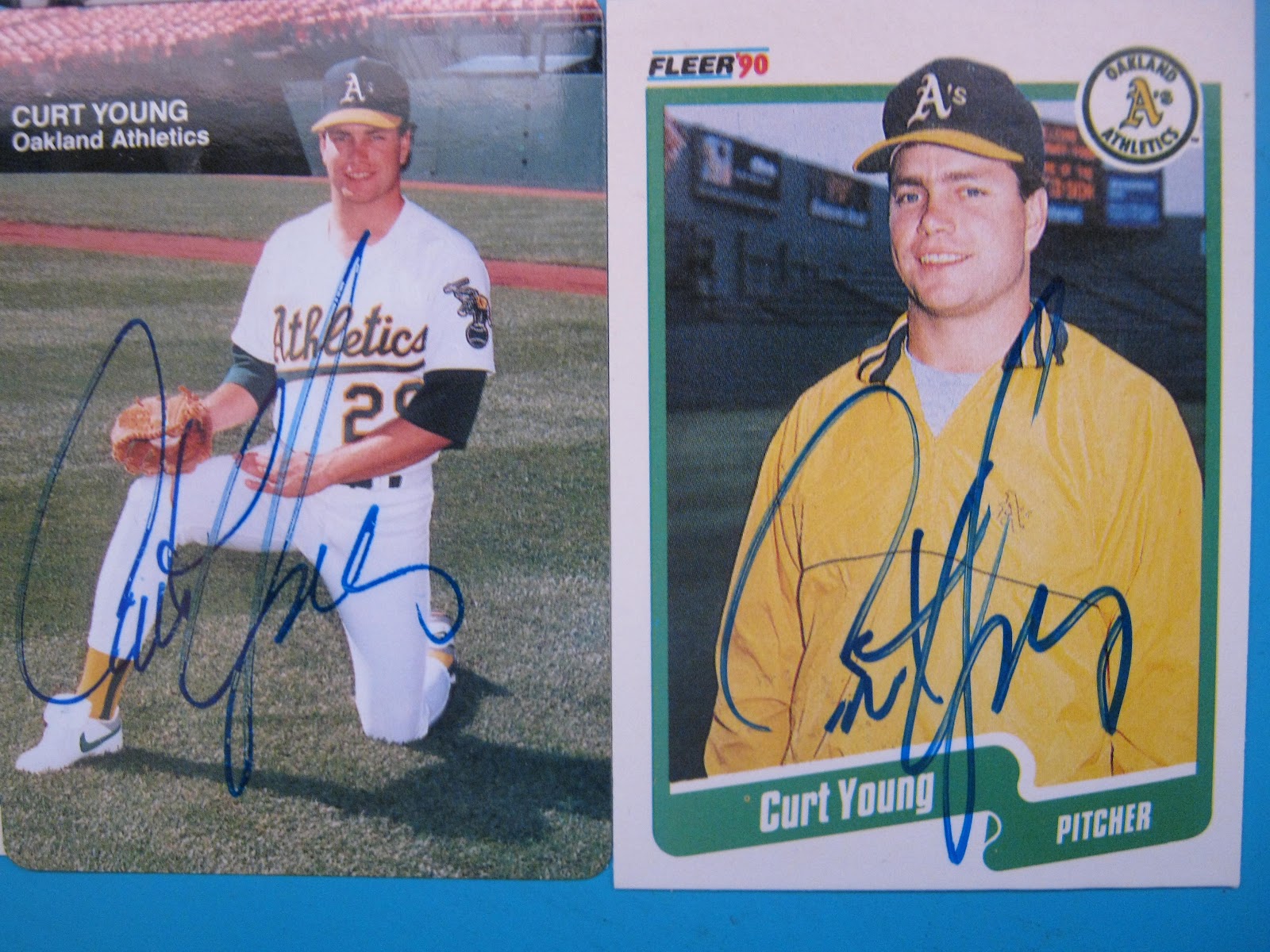
It doesn’t surprise me that Young and Honeycutt are excellent pitching coaches who rarely get the credit they deserve. It’s not in their personality to seek credit. They had moments of great triumph and moments of embarrassing failure as players, so they can relate to every situation.
They also have an acute attention to detail. Admittedly, I’m drawing too many conclusions about a player’s personality based on the style of his autograph.
But when you look at Young and Honeycutt’s signatures, both show attention to detail, substance over flash, penmanship over unnecessary loops, and I think that translates into being an effective pitching coach.
***
My favorite story about dealing with Honeycutt, the pitching coach, was during my first year co-hosting Dodger Talk. Honeycutt was a guest during a spring training show from Vero Beach, Fla., and we were talking about a 20-year-old kid who was just called over from the minor league camp.
“He’s the kind of kid you dream about,” gushed Honeycutt.
The kid was Clayton Kershaw.
Looking back now, it’s funny. Honeycutt was the kind of player you dreamed about as an autograph seeker. He always said yes.
Nowadays, whenever I see Curt Young visit the mound to talk with a pitcher, I think about my first encounter with him in the parking lot. Young played it cool that day, taught me a lesson in a funny way, and made me better at getting Sharpie Scribbles.
On the mound, I can just hear Young telling a young pitcher who is in a jam, “I’ll sign. Just relax, kid.”
Subscribe to:
Posts (Atom)